Hi everyone,
I know I haven't been keeping this blog going, mostly because I want to keep this space for the "Southern Sudan" time in my life, rather than as a catch all for everything that's going on. However, in case anyone is still out there reading once in awhile, I wanted to share these video clips from CNN's coverage of Southern Sudan found on this site: http://edition.cnn.com/2009/WORLD/africa/12/09/sudan.vote.drive/index.html. The reporters went to Juba to do a story on the voter registration (General elections in February 2010!), but ended up with stories about the North South divide, the Wildlife Conservation (elephants and antelope in Sudan!) and oil. The clips show a lot of the people and the towns where I lived and worked, which is fantastic to see, so I just had to make a post.
The story of Daniel Deng, a Sudanese-American who returned to Southern Sudan to help with voter registration in Juba, and the voter registration process in general, can be found here: http://us.cnn.com/video/?/video/world/2009/12/09/mckenzie.sudan.vote.drive.cnn
The next is a video about the efforts of wildlife conservation in Southern Sudan, is here: http://us.cnn.com/video/?/video/world/2009/12/09/mckenzie.sudan.vote.drive.cnn
I met a lot of the people who work for the Wildlife Conservation Society, including Paul Elkin who is interviewed on this clip, and the work they do is truly inspiring.
A look at controversial evidence of the oil industry polluting the drinking water and people's fears is here: http://us.cnn.com/video/?/video/world/2009/12/08/mckenzie.sudan.oil.anxiety.cnn
And finally, the effects of the North-South war on people's lives, some images of what a typical market looks like, and the threat of returning to war if independence is won: http://us.cnn.com/video/?/video/world/2009/12/09/mckenzie.sudan.nation.cnn
It made me so happy to see these videos, it's not often that news agencies give a voice to Southern Sudanese beyond government officials, and show what towns really look like, so I just had to share!
I hope you enjoy :)
Showing posts with label optimism. Show all posts
Showing posts with label optimism. Show all posts
Friday, December 11, 2009


Wednesday, July 22, 2009
Games Day!
A few weeks ago one of my friends organized a Games Day for one of the primary schools in Juba. 200 children in 3rd and 4th grade came out in force, and not even a passing rainshower dampened the spirits! It was a TON of fun and such a tangible way to give back to the community. Even though every day we spend our time focusing on development of Southern Sudan, often it is about the large picture and it is difficult to connect in a real, personal way. About 20 expats showed up to help, and between organizing musical chairs, potato sack races, egg and spoon races, all that good stuff, I'm not sure who had the most fun - us or the students! Below are some pictures from the event - a disproportionate number were from the egg and spoon races, because that's the one I was organizing. The highlights were the musical chairs (definitely a crowd pleaser!) and the tug of war at the end which took 25 minutes to organize and 3 1/2 seconds to do because the rope immediately snapped once the kids started pulling. I took a short video showing the students singing to thank us for the trophy we presented their School's Principal at the end of the day, but the size was 35 MB which given the speed of the internet connection in Sudan means that it would take 11 hours and 31 minutes to upload. So you'll just have to imagine the singing yourself when you look at the last picture. 


Wednesday, March 4, 2009
Desmond Tutu and the ICC
All I can say is WOW after reading this Op-Ed piece by Desmond Tutu in the NYT.
Seriously. Take a moment to read this. It only took the man 500 words to silence critics by reminding everyone of the real point of the ICC - to bring justice for the people that are the "victims of the crimes." Who, in this case, happen to be African.
Seriously. Take a moment to read this. It only took the man 500 words to silence critics by reminding everyone of the real point of the ICC - to bring justice for the people that are the "victims of the crimes." Who, in this case, happen to be African.
..................................................................
Desmond Tutu shook my hand a few years back at a benefit gala thrown by my organization. I turned around, and looking up at me beaming with a great big smile and reaching to shake my hand with both of his was none other than the Nobel Peace Prize winner. By the way, he was looking up at me because the man is 5'3" and with my 4 inch heels (they were fantastic, y'all!) I was about 5'9".
I was in the midst of assisting seating guests of this sparkling black tie event - people like Dave Matthews, Richard Branson (he winked at me, I swear!) and various members of the US Congress. Who cares about all of them, I almost started hyperventilating when I met Desmond Tutu! I felt silly in my black sparkly dress and wanted to be far away from that place, somewhere where I could meet him on my own terms. Oh well, that was still the best handshake I have ever received :)
Still, the article takes an idealistic view, and if I were a smidge less cynical I'd wholeheartedly agree. Don't get me wrong, I want to believe that people do the right thing. But leaders have skewed visions of "reason" and "justice" - that's why the reaction to the ICC's announcement on whether Bashir will be indicted is so uncertian.
Desmond Tutu shook my hand a few years back at a benefit gala thrown by my organization. I turned around, and looking up at me beaming with a great big smile and reaching to shake my hand with both of his was none other than the Nobel Peace Prize winner. By the way, he was looking up at me because the man is 5'3" and with my 4 inch heels (they were fantastic, y'all!) I was about 5'9".
I was in the midst of assisting seating guests of this sparkling black tie event - people like Dave Matthews, Richard Branson (he winked at me, I swear!) and various members of the US Congress. Who cares about all of them, I almost started hyperventilating when I met Desmond Tutu! I felt silly in my black sparkly dress and wanted to be far away from that place, somewhere where I could meet him on my own terms. Oh well, that was still the best handshake I have ever received :)
..........................................................
Still, the article takes an idealistic view, and if I were a smidge less cynical I'd wholeheartedly agree. Don't get me wrong, I want to believe that people do the right thing. But leaders have skewed visions of "reason" and "justice" - that's why the reaction to the ICC's announcement on whether Bashir will be indicted is so uncertian.
Wednesday, January 21, 2009
Hope. Uncynical.
For me, the inauguration ceremony was beautiful. I will probably never forget watching the most important event in America's political system and feeling truly humbled and full of awe. For those of you who know me, I'm not exactly the type to wave flags around singing the star spangled banner and proclaming the United States to be the best country in the world. But yesterday I felt proud of my country. My country. It even sounds strange for me to write out, let alone say. For much of my late teens and early twenties I was disgusted and disillusioned by the actions of the US government and wanted to distance myself. The ignorance and indifference of many Americans to what exists outside their borders contributed to the curent state of the world and I wanted no part of it. Part of the reason I ended up in the career I have (besides getting to travel around the world which is just wicked) is that access to products, services and information that will make people healthier is a global field - it goes beyond the hemming and hawing of domestic politics and can be applied anywhere. So in order to escape I happily left my dreams of working for the State Department behind and embraced my new identity as a citizen of the world.
Fast forward five years later to watching the 44th Presidential Inauguration at the US Consulate in Juba, Southern Sudan.
To me, the most beautiful thing about the inauguration was a point so completely missed by the US media coverage but picked up immediately those of us watching CNN in Juba. It was those few moments where the Obamas walked the Bushes down the Capitol steps to said goodbye making the phrase "transfer of power" literal that struck everyone the most here. Because RW is right - in the "real" world things like this just don't happen (seriously people, go to that link and read the brief post. now. it's what i want to say here but much better).
A peaceful transfer of power is taken for granted in the US but seems like a fairy tale, an ideal that can't exist, for so many people in the world. When Obama said, "To those who cling to power through corruption and deceit and the silencing of dissent, know that you are on the wrong side of history; but that we will extend a hand if you are willing to unclench your fist" it drove home that he knew that he was talking about. He understands that elsewhere in the world people die, dreams are shattered, and nations crumble because of men with large power and small minds who decide to hold their fellow citizens hostage to feed their own ego and own lust for money and power.
But it is sure nice to think it possible for more people to share the hope and joy that exists in the US and there *might* be a point, after all, to people trying to make the world a better place.
Tears rolled down my face when I watched that man speak because I finally realized that I have the right to hope, and always did have that right. I have the right to hope and I refuse to accept the cynical view that my hope is merely being taken in by the rhetoric of a well oiled political machine. I refuse to believe that it is naive to want so badly for the wrongs done over the past 8 years to be undone and for the world to be cleaner, healthier, gentler, better, than it was before that I will actually spend my life working towards that goal. I claim my right to believe for once that maybe, just maybe, world leaders can eventually internalize the statement "know that your people will judge you on what you can build, not what you destroy."
Of course one man can't just skip around sprinkling magical fairy dust and solve these problems - it will take 8 years and more. But there's nothing like a spark of hope at the start and let's hope that momentum will help with the rest. There is no reason for the Obama Administration to change their campaign slogan now that he is in office: Yes. We. Can.
Fast forward five years later to watching the 44th Presidential Inauguration at the US Consulate in Juba, Southern Sudan.
To me, the most beautiful thing about the inauguration was a point so completely missed by the US media coverage but picked up immediately those of us watching CNN in Juba. It was those few moments where the Obamas walked the Bushes down the Capitol steps to said goodbye making the phrase "transfer of power" literal that struck everyone the most here. Because RW is right - in the "real" world things like this just don't happen (seriously people, go to that link and read the brief post. now. it's what i want to say here but much better).
A peaceful transfer of power is taken for granted in the US but seems like a fairy tale, an ideal that can't exist, for so many people in the world. When Obama said, "To those who cling to power through corruption and deceit and the silencing of dissent, know that you are on the wrong side of history; but that we will extend a hand if you are willing to unclench your fist" it drove home that he knew that he was talking about. He understands that elsewhere in the world people die, dreams are shattered, and nations crumble because of men with large power and small minds who decide to hold their fellow citizens hostage to feed their own ego and own lust for money and power.
But it is sure nice to think it possible for more people to share the hope and joy that exists in the US and there *might* be a point, after all, to people trying to make the world a better place.
Tears rolled down my face when I watched that man speak because I finally realized that I have the right to hope, and always did have that right. I have the right to hope and I refuse to accept the cynical view that my hope is merely being taken in by the rhetoric of a well oiled political machine. I refuse to believe that it is naive to want so badly for the wrongs done over the past 8 years to be undone and for the world to be cleaner, healthier, gentler, better, than it was before that I will actually spend my life working towards that goal. I claim my right to believe for once that maybe, just maybe, world leaders can eventually internalize the statement "know that your people will judge you on what you can build, not what you destroy."
Of course one man can't just skip around sprinkling magical fairy dust and solve these problems - it will take 8 years and more. But there's nothing like a spark of hope at the start and let's hope that momentum will help with the rest. There is no reason for the Obama Administration to change their campaign slogan now that he is in office: Yes. We. Can.
Thursday, December 25, 2008
2008 recap/ 2009 resolutions
I've been thinking about the past year - what was good, what was bad, what was joyful, what was sorrowful, and although a lot has happened, I think I have a pretty good handle on how to take things in stride to carry on into 2009. Here is a recap of my year:
January 2008: New Years in DC and Katina & Renzo's wedding in Santiago, Chile! Had a fabulous time but the election violence in Kenya (and the fact that I couldn't get ahold of Simba) were looming. Ended up staying in the US an extra week because flying through Nairobi wasn't deemed completely stable yet, and routing through Ethiopia on my way back to Juba.
February: Went to Zambia for a technical conference on HIV Counseling and Testing, and ended up in the hospital for 3 days with Enterocolitis (bacterial infection in my large intestine) Moved out of my organization's guesthouse (which I shared with my boss and another roomate), and into a house with a new roomate. House was not quite finished, and on the dusty main road, so started my twice-daily sweeping battle with the dust.
March: Started out with a R&R to Pemba, Mozambique with Simba. Lovely, lovely place - motorcycle rides, warm beaches, home-cooked fish, cheap beer, speaking Portuguese - and the trip solidified our relationship. We were a couple before we left, but when we came back we became inseparable. Found out that while I was gone, there was an "alleged" security incident at the house, and therefore I was no longer allowed to live there. Moved into a hotel next to my office while another house was sorted out. Get sick with a stomach bug (3rd time in 6 months). Things REALLY started rolling with my programs at work, massive hiring, trainings, coordination, and fundraising.
April: Had a joint birthday party at Bedouin Bar with a fellow Juba-ite, and it was hailed as one of the best Juba has ever seen - the place was PACKED with hundreds of people, the music was fantastic, and I danced the night away in my Kikoy and Mets t-shirt. Took a boat trip on the Nile with a bunch of friends and a pet monkey, and one of my friends even managed to send me a homemade cake!
May: There started to be a string of armed robberies in Juba, targeting agency compounds. 2 days before I was supposed to move in to my new house, there were 2 attempted robberies on the same block. As a result I was no longer allowed to live in the area because of security concerns. I checked out of the hotel and into a tent at Acacia village, a camp site 9 km from the town center. Longer drive, but it was quiet, and I know I could be there long term until whatever "permanent housing solution" was decided for all the expats working with my organization. Moving 5 times in 8 months was just too much. Climbed up Jebel Kujur for the first time (with a view of the whole county) and celebrated at the top with wine and cheese. It was Gorgeous. Got sick - again. Had a fever of 104 and had to be hooked up to an IV overnight in a clinic. They never really found out what it was - malaria and typhoid tests came back negative, but the antibiotic and malaria treatment helped whatever it was. Go to Nairobi to go to the dentist and also go camping on Lake Naivasha with Simba.
June: The rest of my family came to Africa for the first first time. We met up in Tanzania and went on a very posh safari in the Serengeti and Zanzibar. Amazing time! Super Frenchie and JC come to Juba to work with us, and I am THRILLED to have some more good friends out here. Two more partners in crime in Juba. Adopted a kitten, who promptly divorced me. Boo. :(
July: Remaining tents are finished at Acacia, and the place fills up quickly. Rather than just 3 or 4 of us, there are suddenly 10. More people to kick back with in the evenings, and I feel I have a good, solid, non-judgmental support group at home. Stress at work kicks in at high gear. Targets aren't being met, even with our best efforts, and everyone is feeling the pressure. Nuroticism begins to set in. Am afflicted with Nairobi Eye - the beetle that leaves toxic "acid" behind when squished. This little bugger decides to do so on my face. Takes 10 days to heal.
August: Visit Beatrice and Keir in the UK! Went to London, Stonehenge, Exeter, Cornwall, and had so much Cream Tea that it made me sick. But in a good way :) Simba gets really sick. Turns out it is Hepatitis A and Malaria. He stays at home for 5 weeks.
September: Quiet month. Had a spectacular trip to Mundri. Spectacular as in very very muddy. My colleague delivered her first baby, Patience Samuel. She is very tiny, but beautiful!
October: My friend Jason passed away after a long battle with brain cancer. Heartbreaking but he was still fighting up until the very end. Juba County Commissioner issues an official order banning "Niggerly" behavior in Juba. Women are rounded up and arrested for wearing pants. Working overtime on communications materials, which just refused to go smoothly. Spent a lovely day at an island on the Nile with a bbq, playing cricket and some weird tag game involving a ball and running around. Moved out of the tent and into my brand new pad - air conditioning, hot water, woo hoo!!! Went to Nairobi for a conference and to the border with Uganda and Kenya for a work exchange trip. Got Malaria. Was treated. Got better.
November: Go on R&R on the south coast of Mombasa with Simba. Had an absolutely fabulous time. Had incident on the road with my colleague in which assault and broken headlights and money were involved. Ugh. Things at work were insane. Worked 7 days a week for 4 straight weeks and I was a nervous wreck.
December: World AIDS Day! Went wonderfully, it was a big success. Things went really well at work - we had an all-staff planning meeting, a marketing planning process workshop, and the programs met virtually all of their targets. Ended up the year in Paradise well.
And my resolutions for 2009? Relax more. Try to not take things at work personally (as in do not base my worth as a person on how things go at work) so I am not so manic with my moods based on work. Smile more. Drink less. Instead of stopping to smell the roses, stop to remember what roses smell like (there are no roses in Juba). Any resolutions beyond that would be putting too much pressure on myself. I do that enough as it is :)
Here's to a happy and healthy 2009!
Peace
Thursday, December 11, 2008
Images from Juba World AIDS Day 2008
Evelyn, Chairperson of Juba People Living with HIV/AIDS

Brand new offices!

L to R: UNAIDS Representative, Governor Central Equitoria State, Chairperson Southern Sudan AIDS Commission (SSAC), Northern Sudan Minister of Health, Western Equitoria State Minister of Health, Deputy Chairperson SSAC, ?, UNAIDS Representative, Chairperson Association People Living with HIV (APLWHA) dNorthern Sudan.

Police Band - innauguration of new SSAC and APLWHA offices

Jebel Kujur in the background...


One of the hired buses carrying the APLWHA crashed on the way to their office inauguration - so sad! Luckily no one was seriously injured...

Raising the flags...

Poni and Ukele (2 of my staff)


My Ugandan banana ladies!


Parade coming up the main tarmac road near the Ministries

United Nations Mission In Sudan (UNMIS) contingent in the parade

Onlookers


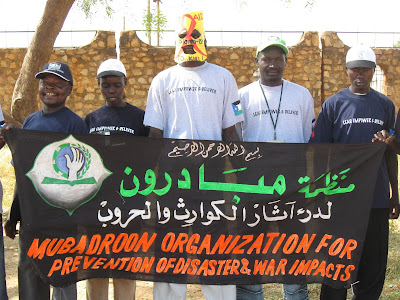
One of the Community Organizations we work with - didn't know they would be so morbid!!!

Brand new offices!

L to R: UNAIDS Representative, Governor Central Equitoria State, Chairperson Southern Sudan AIDS Commission (SSAC), Northern Sudan Minister of Health, Western Equitoria State Minister of Health, Deputy Chairperson SSAC, ?, UNAIDS Representative, Chairperson Association People Living with HIV (APLWHA) dNorthern Sudan.

Police Band - innauguration of new SSAC and APLWHA offices

Jebel Kujur in the background...


One of the hired buses carrying the APLWHA crashed on the way to their office inauguration - so sad! Luckily no one was seriously injured...

Raising the flags...

Poni and Ukele (2 of my staff)


My Ugandan banana ladies!


Parade coming up the main tarmac road near the Ministries

United Nations Mission In Sudan (UNMIS) contingent in the parade

Onlookers


One of the Community Organizations we work with - didn't know they would be so morbid!!!

Tuesday, September 18, 2007
UNMIS running, T-shirt mobs, and Kwacha
So I’ve officially been in Sudan a week now and it already feels as if I’ve been here a month. It’s amazing how quickly you adapt to a new environment when you’re carrying nothing but a few bags with you. It’s not like I have to think about arranging my living space, because I live in a container that holds a rather uncomfortable bed, plastic table and chair, and a dresser/bureau. The air conditioning unit, however, is quite new and runs silently – nary a purr – and because the room is so small (3 paces wide by 4 paces long) it cools off in no time.
Right now I’m sitting outside at the camp which is right on the Nile watching laundry dry on the fence and a little lizard is sunning herself along the wall watching the clothes dry with me. Here's a picture of the view:

The camp is right next to Juba’s port, which has no port-like qualities other than the fact that boats decide to dock there to unload their goods. The Japanese are building a tarmac road that will eventually go down to the port, but apparently they’ve been working on the same stretch of 200 meters for the past 3 months – everything must be perfect! When it is finished it will be Juba’s first tarmac road. There are a lot of met in hardhats walking around and flagging vehicles around the site, but not much work is going on. I don’t quite understand how the construction process goes, but there is a layer of tar, then they dump rocks on top of it, smooth it out, and then more tar? Maybe someone can enlighten me? Sunshine?
When I first got to Juba I wrote out an email with some thoughts about my first couple days – the text of which I am pasting below here:
“I arrived safe and sound in Juba yesterday - and all of my bags even arrived with me! It's a miracle! The trip was fairly stress free - except getting bumped from my flight from Nairobi to Juba and having to wait 4 hours in the airport. But I found a guy from Bolivia to chat with and even talked the airline out of charging me for my extra baggage, so all in all it was fine. I'm staying in a hotel-like compound for the first few weeks until my room in the guest house opens up. So it'll be living out of a suitcase for the first couple weeks. It is a nice place - there's wireless internet (because it's run by Indians), a/c, and it's right on the Nile river (which looks much like a tributary of the Amazon - fast current carrying plants along with it). All in all it's a lot like camp with WiFi - cold showers, bugs, brushing your teeth with water out of a water bottle, and eating in a canteen. Did I mention that it's awesome? I get to wear cargo pants and chacos to work. Needless to say, I'm sure the novelty of all this will fade away, and I'll soon be craving a hot shower and a place to wear cute shoes.
Juba is expensive. Going out to eat costs more than in the US - at least more than the places I eat at...not sure if that says more about me or about Juba... It rained last night and this morning, so everything is muddy. But not quite muddy enough to wear my blue-striped wellies. The potholes are less pot and more bathtub, which makes driving around in landrovers when you have to pee a very bad idea - it's hard to concentrate on holding more than one thing at a time, so you have to choose between steadying yourself with the handle above the window and, well, you know. I haven't seen the famed paved road yet, but I am assured it does indeed exist.
My favorite Juba quirk so far: a sign reading "Dry Cleaner" next to strings of laundry drying in the sun. Oh, and the Ethiopian food here rocks.”
Now a tugboat is bringing out one of the barges from the port. These things are so damn long they look like the spaceship at the beginning of Spaceballs – when it goes by it just keeps going and going and going carrying God knows what up and down the river. It looks like a pile of junk at one end – rusty cars, trucks and motorbikes, piles of bags and unidentified plastic, etc, and then on the other side there are containers.
I feel comfortable here. There’s no stress about looking presentable like there is in DC (cargo pants, a t-shirt and sandals do very nicely), and the little quirks about life here I take all in stride. Like having intermittent power (lanterns do have a certain charm), getting stuck in the mud, and having to deal with absolutely nothing going the way you planned it. I am the queen of last minute preparations and adapting under stress, so I think I’ll find a niche here and be happy.
I had to plan an event for several thousand people that took place this past Saturday. Up until Friday the preparations were going smoothly (except for the person bringing the t-shirts getting stuck in a town 4 hours away for 3 days) until it rained all morning on Saturday. When it rains here, everyone assumes that you don’t work. Everything just shuts down. This is mainly because there is only public transport on one road and it doesn’t run when it rains because the roads are so bad. But even if people live 2 blocks away they assume there is no work. So I had to call most of the staff to say that yes, the event was still on (it was supposed to stop raining in the afternoon) and yes, they need to be at the office as planned to help prepare. So we got started 3 hours late. The truck bringing the tables to the event got stuck in the mud on the way over, the audio system and generator couldn’t be picked up until it stopped raining, the office manager was nowhere to be found, the field where we were set up was all sorts of soggy, and less people showed up than would have otherwise. But everything worked out in the end, and my 7 hour event turned into a 4 hour event which was a blessing. Here's a picture:

and here's one of some cuties with one of our informational brochures on HIV prevention:

I was chatting with a few of the staff yesterday and their theory is that because of the war (which lasted over 20 years) everyone has gotten absolutely everything for free for so long whether from refugee camps, foreign aid, the army, or the government, that now the people who stayed in Sudan during the war don’t want to work. Because why should they? It’s not part of the culture anymore, and because they stayed in Sudan they didn’t learn English and can’t work in the NGO/UN world like the people who fled to Uganda or Kenya and then came back. The people who you see working in Juba are either Kenyans imported by businesses or returning Sudanese who have been living in Kenya or Uganda for a long time and have some education. So now we come to the t-shirt distribution at the event. Everyone expects free handouts and doesn’t understand why they shouldn’t just be able to have them. We had to keep them in a back office with police guards to keep away the mobs of people who would try to grab the t-shirts from whoever brought some out. Kids, adults, everyone. Craziness.
After the event we went to a party at another NGO compound and drank Carlsberg beer out of cans, waited for people to finish watching the Ireland vs. Georgia rugby match, and just hung out and did a bit of dancing. It is IMPOSSIBLE to have a conversation with anyone without one of you asking a) “who do you work for?” and b) “how long are you here for?” within the first two minutes. I had a bit of a freakout session when I realized that would be my social life for the next two years. Scary. I need to find other outlets…
I did, however, get some very good advice there from one of the guys that I played rugby with. He was asking how things were going so far and I was saying that my first week was super busy and that by the end of the event on Saturday I was just glad things ended without rioting or anything catching on fire. He replied that it may seem difficult, but that you should never lower your standards for work here because the lower your standards are the lower quality things will become. This may seem obvious to those of you who live in developed countries, but in a place where nothing works correctly it is important to keep in mind. People are smart, they are just not used to someone expecting a lot out of them.
Another tidbit from the party: the same guy as above who gave me advice asked me if I had worked in Africa before. I replied that I had, but in Southern Africa, not East Africa. He then asked, “Oh, so how are the Kwacha there?” Kwacha is the local word for foreigner or expat. At this point in time I didn’t know that yet. The only thing I knew as a Kwacha is the Zambian currency. So I then launch into a schpeal about how the Kwacha gained a lot of ground about a year ago due to the increase in the price of copper on the world markets which is mined in Zambia, which is all true. Then someone pulled me away. I didn’t find out what Kwacha meant here until the next day, at which point I felt like a total loser. Someone asks me how the expat community is in Southern Africa and I respond by giving a lecture on Zambian currency fluctuations. Serves me right. At least I wasn’t sober at that point plus was meeting everyone for the first time so I don’t remember who it was that asked me the question in the first place.
I went running on Sunday with a couple colleagues around the UNMIS complex, a loop that ends up being somewhere between 3 and 4 miles. It was absolutely lovely. I listened to Madonna’s confessions on a dance floor album while running (which was a bit of a mind bender –listening to the Café Ontario soundtrack that we used to have kitchen dance parties to (here’s a shout-out to Tiff, Ryan, Lisa, Amanda, Mukti and Alexis, I miss you guys so much!!!) while running through a swamp in Sudan. First we ran down a muddy stretch, then turned onto the old runway for the UN planes where there are a ton of HUGE helicopters still parked just chilling there along the whole stretch. The new runway is parallel to that “road” so small planes were landing nearby. After that we turned onto more dirt roads, where there were little yellow birds that looked like goldfinches, high grass, and relative calmness. Then we came to people guiding cattle across what looked like a river that had flooded the road. There was no way around, and the water was about 6 inches deep, so we had to take off our shoes and wade through. Twice. Where cattle had walked. Gross. I don’t even want to think about where that water had been. Eeeeeeeeeeewwwwwwwww. After that we squeezed through the bars of the back gate to the UN complex, and finished up the run waving at Bangladeshi guards and running past containers. And saw a rainbow J. There was also something called “Oxidation Pond” on the way. I don’t know why it is called that, do they dump a bunch of copper there to be oxidized? I have no idea.
That’s all for now, more to follow.
Peace.
Right now I’m sitting outside at the camp which is right on the Nile watching laundry dry on the fence and a little lizard is sunning herself along the wall watching the clothes dry with me. Here's a picture of the view:

The camp is right next to Juba’s port, which has no port-like qualities other than the fact that boats decide to dock there to unload their goods. The Japanese are building a tarmac road that will eventually go down to the port, but apparently they’ve been working on the same stretch of 200 meters for the past 3 months – everything must be perfect! When it is finished it will be Juba’s first tarmac road. There are a lot of met in hardhats walking around and flagging vehicles around the site, but not much work is going on. I don’t quite understand how the construction process goes, but there is a layer of tar, then they dump rocks on top of it, smooth it out, and then more tar? Maybe someone can enlighten me? Sunshine?
When I first got to Juba I wrote out an email with some thoughts about my first couple days – the text of which I am pasting below here:
“I arrived safe and sound in Juba yesterday - and all of my bags even arrived with me! It's a miracle! The trip was fairly stress free - except getting bumped from my flight from Nairobi to Juba and having to wait 4 hours in the airport. But I found a guy from Bolivia to chat with and even talked the airline out of charging me for my extra baggage, so all in all it was fine. I'm staying in a hotel-like compound for the first few weeks until my room in the guest house opens up. So it'll be living out of a suitcase for the first couple weeks. It is a nice place - there's wireless internet (because it's run by Indians), a/c, and it's right on the Nile river (which looks much like a tributary of the Amazon - fast current carrying plants along with it). All in all it's a lot like camp with WiFi - cold showers, bugs, brushing your teeth with water out of a water bottle, and eating in a canteen. Did I mention that it's awesome? I get to wear cargo pants and chacos to work. Needless to say, I'm sure the novelty of all this will fade away, and I'll soon be craving a hot shower and a place to wear cute shoes.
Juba is expensive. Going out to eat costs more than in the US - at least more than the places I eat at...not sure if that says more about me or about Juba... It rained last night and this morning, so everything is muddy. But not quite muddy enough to wear my blue-striped wellies. The potholes are less pot and more bathtub, which makes driving around in landrovers when you have to pee a very bad idea - it's hard to concentrate on holding more than one thing at a time, so you have to choose between steadying yourself with the handle above the window and, well, you know. I haven't seen the famed paved road yet, but I am assured it does indeed exist.
My favorite Juba quirk so far: a sign reading "Dry Cleaner" next to strings of laundry drying in the sun. Oh, and the Ethiopian food here rocks.”
Now a tugboat is bringing out one of the barges from the port. These things are so damn long they look like the spaceship at the beginning of Spaceballs – when it goes by it just keeps going and going and going carrying God knows what up and down the river. It looks like a pile of junk at one end – rusty cars, trucks and motorbikes, piles of bags and unidentified plastic, etc, and then on the other side there are containers.
I feel comfortable here. There’s no stress about looking presentable like there is in DC (cargo pants, a t-shirt and sandals do very nicely), and the little quirks about life here I take all in stride. Like having intermittent power (lanterns do have a certain charm), getting stuck in the mud, and having to deal with absolutely nothing going the way you planned it. I am the queen of last minute preparations and adapting under stress, so I think I’ll find a niche here and be happy.
I had to plan an event for several thousand people that took place this past Saturday. Up until Friday the preparations were going smoothly (except for the person bringing the t-shirts getting stuck in a town 4 hours away for 3 days) until it rained all morning on Saturday. When it rains here, everyone assumes that you don’t work. Everything just shuts down. This is mainly because there is only public transport on one road and it doesn’t run when it rains because the roads are so bad. But even if people live 2 blocks away they assume there is no work. So I had to call most of the staff to say that yes, the event was still on (it was supposed to stop raining in the afternoon) and yes, they need to be at the office as planned to help prepare. So we got started 3 hours late. The truck bringing the tables to the event got stuck in the mud on the way over, the audio system and generator couldn’t be picked up until it stopped raining, the office manager was nowhere to be found, the field where we were set up was all sorts of soggy, and less people showed up than would have otherwise. But everything worked out in the end, and my 7 hour event turned into a 4 hour event which was a blessing. Here's a picture:

and here's one of some cuties with one of our informational brochures on HIV prevention:

I was chatting with a few of the staff yesterday and their theory is that because of the war (which lasted over 20 years) everyone has gotten absolutely everything for free for so long whether from refugee camps, foreign aid, the army, or the government, that now the people who stayed in Sudan during the war don’t want to work. Because why should they? It’s not part of the culture anymore, and because they stayed in Sudan they didn’t learn English and can’t work in the NGO/UN world like the people who fled to Uganda or Kenya and then came back. The people who you see working in Juba are either Kenyans imported by businesses or returning Sudanese who have been living in Kenya or Uganda for a long time and have some education. So now we come to the t-shirt distribution at the event. Everyone expects free handouts and doesn’t understand why they shouldn’t just be able to have them. We had to keep them in a back office with police guards to keep away the mobs of people who would try to grab the t-shirts from whoever brought some out. Kids, adults, everyone. Craziness.
After the event we went to a party at another NGO compound and drank Carlsberg beer out of cans, waited for people to finish watching the Ireland vs. Georgia rugby match, and just hung out and did a bit of dancing. It is IMPOSSIBLE to have a conversation with anyone without one of you asking a) “who do you work for?” and b) “how long are you here for?” within the first two minutes. I had a bit of a freakout session when I realized that would be my social life for the next two years. Scary. I need to find other outlets…
I did, however, get some very good advice there from one of the guys that I played rugby with. He was asking how things were going so far and I was saying that my first week was super busy and that by the end of the event on Saturday I was just glad things ended without rioting or anything catching on fire. He replied that it may seem difficult, but that you should never lower your standards for work here because the lower your standards are the lower quality things will become. This may seem obvious to those of you who live in developed countries, but in a place where nothing works correctly it is important to keep in mind. People are smart, they are just not used to someone expecting a lot out of them.
Another tidbit from the party: the same guy as above who gave me advice asked me if I had worked in Africa before. I replied that I had, but in Southern Africa, not East Africa. He then asked, “Oh, so how are the Kwacha there?” Kwacha is the local word for foreigner or expat. At this point in time I didn’t know that yet. The only thing I knew as a Kwacha is the Zambian currency. So I then launch into a schpeal about how the Kwacha gained a lot of ground about a year ago due to the increase in the price of copper on the world markets which is mined in Zambia, which is all true. Then someone pulled me away. I didn’t find out what Kwacha meant here until the next day, at which point I felt like a total loser. Someone asks me how the expat community is in Southern Africa and I respond by giving a lecture on Zambian currency fluctuations. Serves me right. At least I wasn’t sober at that point plus was meeting everyone for the first time so I don’t remember who it was that asked me the question in the first place.
I went running on Sunday with a couple colleagues around the UNMIS complex, a loop that ends up being somewhere between 3 and 4 miles. It was absolutely lovely. I listened to Madonna’s confessions on a dance floor album while running (which was a bit of a mind bender –listening to the Café Ontario soundtrack that we used to have kitchen dance parties to (here’s a shout-out to Tiff, Ryan, Lisa, Amanda, Mukti and Alexis, I miss you guys so much!!!) while running through a swamp in Sudan. First we ran down a muddy stretch, then turned onto the old runway for the UN planes where there are a ton of HUGE helicopters still parked just chilling there along the whole stretch. The new runway is parallel to that “road” so small planes were landing nearby. After that we turned onto more dirt roads, where there were little yellow birds that looked like goldfinches, high grass, and relative calmness. Then we came to people guiding cattle across what looked like a river that had flooded the road. There was no way around, and the water was about 6 inches deep, so we had to take off our shoes and wade through. Twice. Where cattle had walked. Gross. I don’t even want to think about where that water had been. Eeeeeeeeeeewwwwwwwww. After that we squeezed through the bars of the back gate to the UN complex, and finished up the run waving at Bangladeshi guards and running past containers. And saw a rainbow J. There was also something called “Oxidation Pond” on the way. I don’t know why it is called that, do they dump a bunch of copper there to be oxidized? I have no idea.
That’s all for now, more to follow.
Peace.
Subscribe to:
Posts (Atom)