Life goes on in Sudan, much as it did before I arrived. Roosters start crowing at 6am to accompany the scratchy sound of homemade reed brooms sweeping across the dust outside compounds. Builds discipline and an appreciation for cleanliness in all the girls whose chore it is. My boss starts her morning run at 6:30, after already being awake for 2 hours working away on her laptop and sending emails. The emails often start at 4am and don't end until 11pm. A squadron from the nearby SPLA barracks starts their morning jog which goes up the main road past the camp where we live. Residents can hear their singing and chanting in Dinka through the tent flaps where I more often than not wished away the dawn and hoped for just one more hour of sleep. The line for the shower starts to grow longer, people waiting their turn in towels and plastic flip flops, toothbrushes and shampoo in hand. The camp truly comes alive at 7, with residents tromping their way to breakfast. South Africans in sturdy boots and khaki speaking in a mix of Afrikaans and English. Kenyans joking in Swahili, sitting off on a table by themselves. Eggs, bacon, fried tomatoes, mushrooms, porridge, baked beans and toast. The NGO workers grabbing a Diet Coke and some toast before walking out in flip flops to the fleet of land cruisers which will carry them away to their desk jobs.
Do I miss this all? Definitely. Am I glad to be here, and not there? Absolutely. It's a strange dichotomy that I haven't quite figured out yet. Simba and I were talking the other day about how we don't know if we'll ever "get over" Sudan. Yes it was tough and yes we were ready to leave, but where else would we be able to watch men, women, children, goats, motorbikes and land cruisers, all stripped naked, all being washed in the river? To drive out past the town barrier to discover a broken bridge and therefore a perfect picnic spot to watch the sunset? Decide to drive a tractor to a party because the car wouldn't start? See the joy in women's faces when we go to their village to tell them about how to prevent malaria? Be able to lie together on a blanket under the stars, so so many stars you can't see anywhere in a city? Work 70 or 80 hours during the week but completely let go during the weekends - drinking slushies in the pool or dancing under a thatched roof?
****************************
We met up for dinner with 6 other former Juba-ites who were in town on holiday. So strange to see everyone again in a completely different context. I'm not quite sure how, but we managed to talk about everything except Sudan for the most part of the meal. Because things are not in such a good place right now. Corruption and mismanagement of the government budget are so bad that it will take until 2012 for the government to honor the contracts they have signed for this year. Jonglei state is still awash in violence, with the armed groups now claiming militia status. The latest info is that there are 1,200 armed and organized men carrying out the attacks. That is two batallions worth.
And a little closer to home, at a barbeque at one of the UN agency compounds, a friend of ours, U, was leaving Juba and her husband flew in to help her pack, to move out, and to see where she had been living and working for the past year. The gathering ended but a drunk man (from a country that will remain nameless but rhymes with "Prussia") insisted on staying the night at the compound. He was told he had to leave by our friend A, but obviously he did not like that answer because he punched A right in the face. U's husband got up to try to deal with the drunk guy, but was punched in the chest. He fell down and never got back up. He died, right there. From the punch in the chest. Does this really happen? Ever? U went back to her country (in Eastern Europe), and the assailant got deported back to his country. No one in Sudan can officially charge or touch him because he worked for the UN, and no legal action will be taken against him because honestly no one cares back in his country. U is now taking things day by day. It's been about a month since this happened, and she is obviously still devastated. Learning to live on her own. She has never paid a bill in her life - she met her husband in college, he took care of everything until she finished grad school, and then she started working in international development where the agencies pay for everything. My god I don't know what I would do.
There is no rhyme or reason to any of this, and it seems like things are going to pieces. People ask me "how is it over there in Sudan" and half the time I don't even know what to answer. I think the only hope the country has right now is the referendum coming up in 2011 where at least the government has a chance to be legitimized and can "insha'allah" take responsibility and pull together. But once the element of a common "enemy" is removed, will the hundreds of tribes be able to rally together under one flag, or will they turn back against each other as has happened since the dawn of time?
************************
Apologies for the far from upbeat post, but that's where I am at the moment. Every year around September 11th I get more introspective, reliving that day, and remembering that in many places around the world that is the norm of life, rather than the exception. It was so good to see people from a different time and place that is still so familiar, but yet so far away now. The idea that I will never see or do any of the things in the first part of the post again still has not yet sunk in. But I am sure that no matter where I am I can create a sense of adventure, a sense of romance and fun because you can't have hope without first glimpsing dispair and you can't appreciate the good without the bad.
Showing posts with label Jubalicious. Show all posts
Showing posts with label Jubalicious. Show all posts
Saturday, September 12, 2009


Wednesday, July 22, 2009
Games Day!
A few weeks ago one of my friends organized a Games Day for one of the primary schools in Juba. 200 children in 3rd and 4th grade came out in force, and not even a passing rainshower dampened the spirits! It was a TON of fun and such a tangible way to give back to the community. Even though every day we spend our time focusing on development of Southern Sudan, often it is about the large picture and it is difficult to connect in a real, personal way. About 20 expats showed up to help, and between organizing musical chairs, potato sack races, egg and spoon races, all that good stuff, I'm not sure who had the most fun - us or the students! Below are some pictures from the event - a disproportionate number were from the egg and spoon races, because that's the one I was organizing. The highlights were the musical chairs (definitely a crowd pleaser!) and the tug of war at the end which took 25 minutes to organize and 3 1/2 seconds to do because the rope immediately snapped once the kids started pulling. I took a short video showing the students singing to thank us for the trophy we presented their School's Principal at the end of the day, but the size was 35 MB which given the speed of the internet connection in Sudan means that it would take 11 hours and 31 minutes to upload. So you'll just have to imagine the singing yourself when you look at the last picture. 


Tuesday, June 23, 2009
Read this article!!!!!
This is the best article I have seen about Southern Sudan in a long, long time. Please read it.
http://www.guardian.co.uk/world/2009/jun/21/sudan-humanitarian-disaster
Interestingly enough, my organization facilitated the visit of the two reporters to Juba 2 weeks ago. They were supposed to be writing about Malaria in Southern Sudan. This is what they wrote instead.
http://www.guardian.co.uk/world/2009/jun/21/sudan-humanitarian-disaster
Interestingly enough, my organization facilitated the visit of the two reporters to Juba 2 weeks ago. They were supposed to be writing about Malaria in Southern Sudan. This is what they wrote instead.
Thursday, April 23, 2009
Connecting with the Land
What is it about Juba that makes me numb everything beautiful? It sounds harsh, but is true.
Last weekend I was sitting outside at a table under a tree and realized that if I was anywhere else (my parent's backyard, or my former backyard in DC came to mind), I would think this simple act was relaxing and beautiful. But instead I noticed the breeze, looked up at the way the Acacia tree's thorns and leaves and small yellow flowers contrasted with the blue sky, heard the bird chirping and hopping around next to its nest, and felt...empty. These small things usually make an impact on me, make my heart swell, put me at peace. But here? I just cannot get there.
The next day Simba and I took a drive out past town and parked on a side road that ends at a broken bridge so the traffic would not disturb us. We sat on the spare tire on the roof of the landcruiser, watched the sun set over the hills, became part of the day turning into dusk and preparing for evening. Anywhere else this would be moving and calming. While it was wonderful, I still felt...almost nothing.
Why is it that as hard as I try, I cannot build a connection with this land? So many parts of our world speak to me - forests, mountains, beaches, deserts - but here? Not so much. I feel that I've failed in some way with that aspect of my life here.
My mom sent me a poem a while back about the need to say goodbye not only to the people but to the land. This is what I am trying to get to, but for some reason have fallen short. And I am not sure I will understand the reasons why until later, much later.
Mameen
Be infinitesimal under that sky, a creature
even the sailing hawk misses, a wraith
among the rocks where the mist parts slowly.
Recall the way mere mortals are overwhelmed
by circumstance, how great reputations
dissolve with infirmity and how you,
in particular, live a hairsbreadth from losing
everyone you hold dear.
Then, look back down the path as if seeing
your past and then south over the hazy blue
coast as if present to a wide future.
Remember the way you are all possibilities
you can see and how you live best
as an appreciator of horizons,
whether you reach them or not.
Admit that once you have got up
from your chair and opened the door,
once you have walked out into the clean air
toward that edge and taken the path up high
beyond the ordinary, you have become
the privileged and the pilgrim,
the one who will tell the story
and the one, coming back
from the mountain,
who helped to make it.
~David Whyte
Last weekend I was sitting outside at a table under a tree and realized that if I was anywhere else (my parent's backyard, or my former backyard in DC came to mind), I would think this simple act was relaxing and beautiful. But instead I noticed the breeze, looked up at the way the Acacia tree's thorns and leaves and small yellow flowers contrasted with the blue sky, heard the bird chirping and hopping around next to its nest, and felt...empty. These small things usually make an impact on me, make my heart swell, put me at peace. But here? I just cannot get there.
The next day Simba and I took a drive out past town and parked on a side road that ends at a broken bridge so the traffic would not disturb us. We sat on the spare tire on the roof of the landcruiser, watched the sun set over the hills, became part of the day turning into dusk and preparing for evening. Anywhere else this would be moving and calming. While it was wonderful, I still felt...almost nothing.
Why is it that as hard as I try, I cannot build a connection with this land? So many parts of our world speak to me - forests, mountains, beaches, deserts - but here? Not so much. I feel that I've failed in some way with that aspect of my life here.
My mom sent me a poem a while back about the need to say goodbye not only to the people but to the land. This is what I am trying to get to, but for some reason have fallen short. And I am not sure I will understand the reasons why until later, much later.
Mameen
Be infinitesimal under that sky, a creature
even the sailing hawk misses, a wraith
among the rocks where the mist parts slowly.
Recall the way mere mortals are overwhelmed
by circumstance, how great reputations
dissolve with infirmity and how you,
in particular, live a hairsbreadth from losing
everyone you hold dear.
Then, look back down the path as if seeing
your past and then south over the hazy blue
coast as if present to a wide future.
Remember the way you are all possibilities
you can see and how you live best
as an appreciator of horizons,
whether you reach them or not.
Admit that once you have got up
from your chair and opened the door,
once you have walked out into the clean air
toward that edge and taken the path up high
beyond the ordinary, you have become
the privileged and the pilgrim,
the one who will tell the story
and the one, coming back
from the mountain,
who helped to make it.
~David Whyte
Tuesday, March 17, 2009
I need me some inspiration
If anyone could send me a little inspiration, I'd be grateful. I'm at a point where I know that I'm leaving as does my employer and my staff, handing off my current position and starting another short term one (same organization) for the last 4 months so I know I won't get bored or antsy. But how to avoid the inevitable rush to the end? When you only focus on the event and date in the future and forget to pay attention to what is happening in the meantime, forget to smell the roses, so to speak?
Well there aren't any roses in Sudan, so I need something else to stop and "smell." Any ideas?
There is of course the new position, I could learn to ride a motorbike (was supposed to on Sunday but slept through my lesson...whoops), take up yoga, start running...but all these things take effort and energy is not something I have in plenty at the moment. I need a change of mindset, or an attitude adjustment (which was actually the name of my Granddad's boat, funnily enough!).
Also, today is Simba's interview for his tourist visa to the US. Since Kenya isn't exactly a card carrying member of the visa waiver program. It's insane the hoops he had to jump through. I'm nervous. Cross your fingers for us!
Well there aren't any roses in Sudan, so I need something else to stop and "smell." Any ideas?
There is of course the new position, I could learn to ride a motorbike (was supposed to on Sunday but slept through my lesson...whoops), take up yoga, start running...but all these things take effort and energy is not something I have in plenty at the moment. I need a change of mindset, or an attitude adjustment (which was actually the name of my Granddad's boat, funnily enough!).
Also, today is Simba's interview for his tourist visa to the US. Since Kenya isn't exactly a card carrying member of the visa waiver program. It's insane the hoops he had to jump through. I'm nervous. Cross your fingers for us!
Monday, February 9, 2009
Juba Market Pictures
I am working on designing/producing a nutritional guide for people living with HIV that has pictures of foods they can find in the markets in their own communities, so my team and I spent a few hours traipsing around the market taking photos of various food. Some of them came out beautifully, so here I present to you a tapestry of the Juba Market Foods. Enjoy!
Bananas. Aren't they so small and cute?

Sugar Cane - just hack off a piece with a machete and chew on it to get your sugar fix.

Cooking Oil. Thick and gross.

Cabbages (used instead of lettuce in EVERYTHING)

Avocados - the buttery kind

Bread

Tomatoes

Pineapples (always disliked pineapple until I moved to Juba - they taste SO GOOD)

Limes/lemons (depends on who you ask)

Eggplant

Typical salad. Ok this wasn't from the market, but it's pretty, no?

Dried sardines

Amaranthus (cooked like Spinach) - the dark pink flowers are called Foxtail for those of you in the US.

Hard Boiled Eggs (on-the-go snack with a pinch of salt. little girls sell these by carrying them on their heads)

Peanuts (or "groundnuts" as they are called here)

Beans

Honey from Western Equitoria sold in water bottles (notice the bee???)

Cassava roots (pounded into a gooey starchy substance and eaten with everything)

Rice

Fish (imported from Uganda - heaven forbid anything actually originate from Southern Sudan)

Bananas. Aren't they so small and cute?

Sugar Cane - just hack off a piece with a machete and chew on it to get your sugar fix.

Cooking Oil. Thick and gross.

Cabbages (used instead of lettuce in EVERYTHING)

Avocados - the buttery kind

Bread

Tomatoes

Pineapples (always disliked pineapple until I moved to Juba - they taste SO GOOD)

Limes/lemons (depends on who you ask)

Eggplant

Typical salad. Ok this wasn't from the market, but it's pretty, no?

Dried sardines

Amaranthus (cooked like Spinach) - the dark pink flowers are called Foxtail for those of you in the US.

Hard Boiled Eggs (on-the-go snack with a pinch of salt. little girls sell these by carrying them on their heads)

Peanuts (or "groundnuts" as they are called here)

Beans

Honey from Western Equitoria sold in water bottles (notice the bee???)

Cassava roots (pounded into a gooey starchy substance and eaten with everything)

Rice

Fish (imported from Uganda - heaven forbid anything actually originate from Southern Sudan)

Thursday, December 25, 2008
2008 recap/ 2009 resolutions
I've been thinking about the past year - what was good, what was bad, what was joyful, what was sorrowful, and although a lot has happened, I think I have a pretty good handle on how to take things in stride to carry on into 2009. Here is a recap of my year:
January 2008: New Years in DC and Katina & Renzo's wedding in Santiago, Chile! Had a fabulous time but the election violence in Kenya (and the fact that I couldn't get ahold of Simba) were looming. Ended up staying in the US an extra week because flying through Nairobi wasn't deemed completely stable yet, and routing through Ethiopia on my way back to Juba.
February: Went to Zambia for a technical conference on HIV Counseling and Testing, and ended up in the hospital for 3 days with Enterocolitis (bacterial infection in my large intestine) Moved out of my organization's guesthouse (which I shared with my boss and another roomate), and into a house with a new roomate. House was not quite finished, and on the dusty main road, so started my twice-daily sweeping battle with the dust.
March: Started out with a R&R to Pemba, Mozambique with Simba. Lovely, lovely place - motorcycle rides, warm beaches, home-cooked fish, cheap beer, speaking Portuguese - and the trip solidified our relationship. We were a couple before we left, but when we came back we became inseparable. Found out that while I was gone, there was an "alleged" security incident at the house, and therefore I was no longer allowed to live there. Moved into a hotel next to my office while another house was sorted out. Get sick with a stomach bug (3rd time in 6 months). Things REALLY started rolling with my programs at work, massive hiring, trainings, coordination, and fundraising.
April: Had a joint birthday party at Bedouin Bar with a fellow Juba-ite, and it was hailed as one of the best Juba has ever seen - the place was PACKED with hundreds of people, the music was fantastic, and I danced the night away in my Kikoy and Mets t-shirt. Took a boat trip on the Nile with a bunch of friends and a pet monkey, and one of my friends even managed to send me a homemade cake!
May: There started to be a string of armed robberies in Juba, targeting agency compounds. 2 days before I was supposed to move in to my new house, there were 2 attempted robberies on the same block. As a result I was no longer allowed to live in the area because of security concerns. I checked out of the hotel and into a tent at Acacia village, a camp site 9 km from the town center. Longer drive, but it was quiet, and I know I could be there long term until whatever "permanent housing solution" was decided for all the expats working with my organization. Moving 5 times in 8 months was just too much. Climbed up Jebel Kujur for the first time (with a view of the whole county) and celebrated at the top with wine and cheese. It was Gorgeous. Got sick - again. Had a fever of 104 and had to be hooked up to an IV overnight in a clinic. They never really found out what it was - malaria and typhoid tests came back negative, but the antibiotic and malaria treatment helped whatever it was. Go to Nairobi to go to the dentist and also go camping on Lake Naivasha with Simba.
June: The rest of my family came to Africa for the first first time. We met up in Tanzania and went on a very posh safari in the Serengeti and Zanzibar. Amazing time! Super Frenchie and JC come to Juba to work with us, and I am THRILLED to have some more good friends out here. Two more partners in crime in Juba. Adopted a kitten, who promptly divorced me. Boo. :(
July: Remaining tents are finished at Acacia, and the place fills up quickly. Rather than just 3 or 4 of us, there are suddenly 10. More people to kick back with in the evenings, and I feel I have a good, solid, non-judgmental support group at home. Stress at work kicks in at high gear. Targets aren't being met, even with our best efforts, and everyone is feeling the pressure. Nuroticism begins to set in. Am afflicted with Nairobi Eye - the beetle that leaves toxic "acid" behind when squished. This little bugger decides to do so on my face. Takes 10 days to heal.
August: Visit Beatrice and Keir in the UK! Went to London, Stonehenge, Exeter, Cornwall, and had so much Cream Tea that it made me sick. But in a good way :) Simba gets really sick. Turns out it is Hepatitis A and Malaria. He stays at home for 5 weeks.
September: Quiet month. Had a spectacular trip to Mundri. Spectacular as in very very muddy. My colleague delivered her first baby, Patience Samuel. She is very tiny, but beautiful!
October: My friend Jason passed away after a long battle with brain cancer. Heartbreaking but he was still fighting up until the very end. Juba County Commissioner issues an official order banning "Niggerly" behavior in Juba. Women are rounded up and arrested for wearing pants. Working overtime on communications materials, which just refused to go smoothly. Spent a lovely day at an island on the Nile with a bbq, playing cricket and some weird tag game involving a ball and running around. Moved out of the tent and into my brand new pad - air conditioning, hot water, woo hoo!!! Went to Nairobi for a conference and to the border with Uganda and Kenya for a work exchange trip. Got Malaria. Was treated. Got better.
November: Go on R&R on the south coast of Mombasa with Simba. Had an absolutely fabulous time. Had incident on the road with my colleague in which assault and broken headlights and money were involved. Ugh. Things at work were insane. Worked 7 days a week for 4 straight weeks and I was a nervous wreck.
December: World AIDS Day! Went wonderfully, it was a big success. Things went really well at work - we had an all-staff planning meeting, a marketing planning process workshop, and the programs met virtually all of their targets. Ended up the year in Paradise well.
And my resolutions for 2009? Relax more. Try to not take things at work personally (as in do not base my worth as a person on how things go at work) so I am not so manic with my moods based on work. Smile more. Drink less. Instead of stopping to smell the roses, stop to remember what roses smell like (there are no roses in Juba). Any resolutions beyond that would be putting too much pressure on myself. I do that enough as it is :)
Here's to a happy and healthy 2009!
Peace
Thursday, December 11, 2008
Images from Juba World AIDS Day 2008
Evelyn, Chairperson of Juba People Living with HIV/AIDS

Brand new offices!

L to R: UNAIDS Representative, Governor Central Equitoria State, Chairperson Southern Sudan AIDS Commission (SSAC), Northern Sudan Minister of Health, Western Equitoria State Minister of Health, Deputy Chairperson SSAC, ?, UNAIDS Representative, Chairperson Association People Living with HIV (APLWHA) dNorthern Sudan.

Police Band - innauguration of new SSAC and APLWHA offices

Jebel Kujur in the background...


One of the hired buses carrying the APLWHA crashed on the way to their office inauguration - so sad! Luckily no one was seriously injured...

Raising the flags...

Poni and Ukele (2 of my staff)


My Ugandan banana ladies!


Parade coming up the main tarmac road near the Ministries

United Nations Mission In Sudan (UNMIS) contingent in the parade

Onlookers


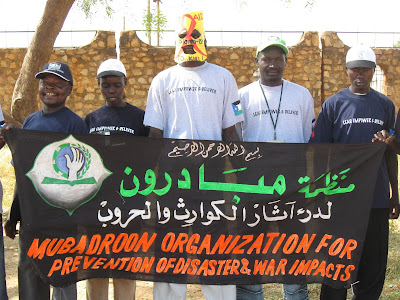
One of the Community Organizations we work with - didn't know they would be so morbid!!!

Brand new offices!

L to R: UNAIDS Representative, Governor Central Equitoria State, Chairperson Southern Sudan AIDS Commission (SSAC), Northern Sudan Minister of Health, Western Equitoria State Minister of Health, Deputy Chairperson SSAC, ?, UNAIDS Representative, Chairperson Association People Living with HIV (APLWHA) dNorthern Sudan.

Police Band - innauguration of new SSAC and APLWHA offices

Jebel Kujur in the background...


One of the hired buses carrying the APLWHA crashed on the way to their office inauguration - so sad! Luckily no one was seriously injured...

Raising the flags...

Poni and Ukele (2 of my staff)


My Ugandan banana ladies!


Parade coming up the main tarmac road near the Ministries

United Nations Mission In Sudan (UNMIS) contingent in the parade

Onlookers


One of the Community Organizations we work with - didn't know they would be so morbid!!!

Monday, November 17, 2008
When those "situations" become personal
As we turned the bend on the way into work, my boss pulled the car over and said, "Get out and act calm." I swiveled in my seat and saw my colleague outside her vehicle arguing with a man who was visibly angry and yelling at her. Not one to be shy, she was standing up to him and yelling right back. A policeman from the opposite side of the intersection walked over to try to address the situation, and I got out of the car and walked over with my peacemaker face on. The policeman manged to get the two of them to move their collided vehicles away from the middle of the road, the passengers in the matatus silently got down from the vehicle to surrounded me, my colleague, the driver, the policeman, and a bystander who spoke English, and the negotiations began.
Standing outside by the side of a Juba road in the rain on a Monday morning trying to negotiate with a drunken matatu driver on how much money we would pay him for his broken light after he ran into my colleague's vehicle was not how I wanted to start my week.
However, my boss obviously wanted me to deal with the situation, not this other woman, so for the second time since I've been here I was the one to negotiate with matatu drivers on behalf of other woman colleagues who were unwilling or unable to do so.
Three times the market rate for the cost of parts and labor for the broken light? Come on, two times? Doesn't matter that we had our mechanic on the phone with the policeman telling him how much everything costs on the market, the policeman just shrugged his shoulders, said, "It's raining, give him what he asks for."
After 30 minutes we accepted, "fine, here's your money," and I got the translator to translate him a lecture about him being a "very bad person" (I'm so eloquent, aren't I?). But then my boss and the colleague said "what about him hitting her?" What? When did this happen? Turns out when the two vehicles collided and the matatu driver left the car, he opened the car door of my colleague, grabbed her arm out and started hitting her arms and chest. Because I did not see that part of the incident I had no idea, but was obviously approaching the negotiations in entirely the wrong way. This new element was addressed with the policeman, who again shrugged his shoulders pointing skyward at the falling ran, and proceeded to walk away.
Given some of the proscribed gender roles in Southern Sudan, including the attitude that "If you pay cows for a woman, then of course you can beat her. If you want to give me your daughter for free, maybe we can talk." it's not surprising that we were treated this way.
Here in Southern Sudan, even though there are many different tribes, marriage customs are very similar. Generally men get married when they can afford to buy enough cows to give to the bride's family - a reverse dowry of sorts - which means they are usually in their late 20's when they marry for the first time. Men can have anywhere from 1 to 4 wives, although I've met men that have 10. Whole families help the man out (uncles, father, grandfather, etc) with the 20 to 150 cows depending on the wealth of the family and the community. Cows cost anywhere from $500 to $1,000 a head depending on the size of the cow. Generally, the larger and more crooked the horns, the better. The man pays for the wedding celebrations too. Women (often girls really) are anywhere from 15-20 when they get married, even if they are educated in other East African countries. Babies come immediately after marriage, and men can even "return" a woman to her family if she is unable to have children. This has a lot to do with society as a whole - I know women that have directly asked their husbands to marry a co-wife so they can share the burden of chores and raising children with another woman.
If it seems to you that women here are treated as commodities to be bought and sold, you're not the only one, and it is quite difficult to be here seeing it first hand.
Driving away from the incident, feeling sick inside, my stomach turned into a bottomless pit of guilt. What could I, should I, have done differently? The answer is nothing. There is nothing I could have said or done which would change how the policeman or the matatu driver viewed the situation. All they saw was a woman, and a broken headlight, and a target on which to...to...to what? To take out their frustration of having peace but not yet prosperity? To take advantage of an opportunity to make a quick and easy profit? To assert their "manliness"? To be fair there really is no way to know whether the incident was a result of them taking advantage of women or whether it was them taking advantage of khawajas (white people). Maybe a combination of both.
In the end, the policeman and driver paid for their mistake but not by our design. The colleague driving the car involved in the accident was here in Juba working for the Minister of Labour. She didn't want to say anything to the Minister, but a friend of hers did a few days later when her bruises started showing, and he proceeded to find out what happened, and find the people involved. The policeman was fired, and the matatu driver was arrested. God only knows what happens inside Sudanese prisons.
What are those two men thinking about now, looking back at things? Do they respect the fact that the law (written or not) saw them in the wrong? Will they become more bitter and act even worse if a similar incident happens again in the future? I'm not sure. But I do know that we all have a long, long way to go.
And next time, you'd better believe I will spend all day if I have to filing an official report with the police, no matter how futile the effort may seem at first.
"Hope will never be silent" ~Harvey Milk
Standing outside by the side of a Juba road in the rain on a Monday morning trying to negotiate with a drunken matatu driver on how much money we would pay him for his broken light after he ran into my colleague's vehicle was not how I wanted to start my week.
However, my boss obviously wanted me to deal with the situation, not this other woman, so for the second time since I've been here I was the one to negotiate with matatu drivers on behalf of other woman colleagues who were unwilling or unable to do so.
Three times the market rate for the cost of parts and labor for the broken light? Come on, two times? Doesn't matter that we had our mechanic on the phone with the policeman telling him how much everything costs on the market, the policeman just shrugged his shoulders, said, "It's raining, give him what he asks for."
After 30 minutes we accepted, "fine, here's your money," and I got the translator to translate him a lecture about him being a "very bad person" (I'm so eloquent, aren't I?). But then my boss and the colleague said "what about him hitting her?" What? When did this happen? Turns out when the two vehicles collided and the matatu driver left the car, he opened the car door of my colleague, grabbed her arm out and started hitting her arms and chest. Because I did not see that part of the incident I had no idea, but was obviously approaching the negotiations in entirely the wrong way. This new element was addressed with the policeman, who again shrugged his shoulders pointing skyward at the falling ran, and proceeded to walk away.
Given some of the proscribed gender roles in Southern Sudan, including the attitude that "If you pay cows for a woman, then of course you can beat her. If you want to give me your daughter for free, maybe we can talk." it's not surprising that we were treated this way.
Here in Southern Sudan, even though there are many different tribes, marriage customs are very similar. Generally men get married when they can afford to buy enough cows to give to the bride's family - a reverse dowry of sorts - which means they are usually in their late 20's when they marry for the first time. Men can have anywhere from 1 to 4 wives, although I've met men that have 10. Whole families help the man out (uncles, father, grandfather, etc) with the 20 to 150 cows depending on the wealth of the family and the community. Cows cost anywhere from $500 to $1,000 a head depending on the size of the cow. Generally, the larger and more crooked the horns, the better. The man pays for the wedding celebrations too. Women (often girls really) are anywhere from 15-20 when they get married, even if they are educated in other East African countries. Babies come immediately after marriage, and men can even "return" a woman to her family if she is unable to have children. This has a lot to do with society as a whole - I know women that have directly asked their husbands to marry a co-wife so they can share the burden of chores and raising children with another woman.
If it seems to you that women here are treated as commodities to be bought and sold, you're not the only one, and it is quite difficult to be here seeing it first hand.
Driving away from the incident, feeling sick inside, my stomach turned into a bottomless pit of guilt. What could I, should I, have done differently? The answer is nothing. There is nothing I could have said or done which would change how the policeman or the matatu driver viewed the situation. All they saw was a woman, and a broken headlight, and a target on which to...to...to what? To take out their frustration of having peace but not yet prosperity? To take advantage of an opportunity to make a quick and easy profit? To assert their "manliness"? To be fair there really is no way to know whether the incident was a result of them taking advantage of women or whether it was them taking advantage of khawajas (white people). Maybe a combination of both.
In the end, the policeman and driver paid for their mistake but not by our design. The colleague driving the car involved in the accident was here in Juba working for the Minister of Labour. She didn't want to say anything to the Minister, but a friend of hers did a few days later when her bruises started showing, and he proceeded to find out what happened, and find the people involved. The policeman was fired, and the matatu driver was arrested. God only knows what happens inside Sudanese prisons.
What are those two men thinking about now, looking back at things? Do they respect the fact that the law (written or not) saw them in the wrong? Will they become more bitter and act even worse if a similar incident happens again in the future? I'm not sure. But I do know that we all have a long, long way to go.
And next time, you'd better believe I will spend all day if I have to filing an official report with the police, no matter how futile the effort may seem at first.
"Hope will never be silent" ~Harvey Milk
Wednesday, October 15, 2008
one step forward, 2 steps back

Remember the apparently "fluke" incident with women being arrested for wearing trousers in Yei? Well, the same has now come to Juba, even being picked up by Reuters and the New York Times. And what sparked this latest rampage? County Local Order No. 4/2008 issued by the Juba County Commissioner "Banning of 'Niggers' Behaviours & Activities in the Town." This Public Order motivated Police to mount an arretst campaign against women and girls wearing trousers in streets and public places. These women were collected from streets, outside worship centers/churches, and public markets, and hauled up into police trucks. Girls were humiliated and taken into custody. This included civilians, UN employees, etc. Luckily people intervened and everyone was released with no charge.
WHAT. THE. FUCK???
And WHAT in GOD'S NAME prompted this order labeling behavior "niggerly"? What is that? And who are these people who are "now known as 'Niggers' in Juba County"? It's not like they give examples in the circular. I have NEVER heard this term being used here, and neither has anyone else (expat or Sudanese) that I've spoken with - but now it's become a joke, especially among Sudanese. From what we can tell, in this context, "niggers" are the Kenyans/Ugandans or Sudanese who have returned from those places who frequent bars and prostitutes, and, apparently, wear trousers. What it looks like is the Commissioner wanted to crack down on the drinking and other "immoral" behavior that is adverseley influencing the citizens of Juba, and this was his solution. From my perspective, I have never in my life heard people using this horrible term so freely and it freaks me out every time. Incredulous.
After these incidents the Juba County Commissioner has been sacked, and replaced by the Central Equitoria State Minister of Health (who I LOVE). But seriously. This serves as a reminder that even though we are in the South, this is still Sudan with a government in its infancy and a society that is still trying to navigate the effects of opening up the country after being effectively cut off from the outside for half a century.
Sunday, September 7, 2008
Welcome to Patience Samuel!


At about 5am on August 17th, my colleague Poni gave birth to her first child, named Patience Samuel. Isn't she cute??? I believe she was about a month premature, because she was very tiny (they did not weigh her at birth, but these pictures were taken when she was 14 days old so she couldn't have been more than 6lbs when she was born) and Poni was not that big when she delivered.
Both Poni and her baby are both health and happy, but unfortunately the delivery did not go entirely well.What Poni told me was that she went into labour at about 10pm on Saturday night, when she went to Juba Teaching Hospital accompanied by her sister. She was in a room in labour for about 7 hours, mostly unattended, when the hospital staff brought her into the delivery room. Then they told her it was her time, and they started the pushing process, and cut her vagina open to assist in the delivery. She had 6 stitches put in, one of which was still in when I went to visit her 2 weeks after the birth.
Now, I know next to nothing about pregnancy, childbirth, etc, but cutting someone open, when they are to deliver a tinier-than-average baby, after only 7 hours (isn't the average something like 8 hours?)? To begin with, I had never heard of women being cut open to begin with, but even so, that seems incredulous to me. Again, I wasn't there, but Poni said even the midwife who came to her house to look after her and take out her stiches said that they should not have cut her open like that.
What it looks like to me is that it was a Saturday night/Sunday morning, the hospital was not fully staffed, and the medical personnel just wanted to hurry things along instead of letting the birth happen naturally. Gotta love that Juba Teaching Hospital is the main referral hospital in the country and this is the kind of care that is rendered there.
Are there any reasons in the above scenario where cutting would have been justified? I know many of you readers have had children or are in the health care profession, so I would appreciate some feedback.
Peace
Saturday, July 19, 2008
Do goats shed their hooves?
My friends are SO supportive. As one said in a chat with me the other day in response to a conversation about the implications of the potential ICC indictment: "get your crazy international-development ass out of the heart of darkness!" Can't you just feel the love? However, what is ironic about the statement is that this particular friend happens to be not in a place that is rebuilding from war, but a place that is actually STILL AT war, and instead of being able to run towards the airport at the first sign of trouble like the good little NGO employee that I am, he is one of the people that would be sent INTO the situation at the first sign of trouble. But I'm not going to say exactly where he is...(kough, kough, KABUL) Sorry starcaviar, I had to call you out on that one :)
This morning I walked outside my tent and lo and behold, what do I see but a goat hoof. Not attached to a leg or anything, but it was just the hoof lying there by itself. Were goats having a midnight frolic on my porch and one of their hooves fall/tear off? Or did the dogs find the hoof somewhere in some field and leave it on my doorstep as a present? Either way i didn't even know that goats could lose their hoofs. So strange. I completely forgot to take a picture of it, otherwise I could display it here for all to see. Instead, I have some other pictures taken over the past couple weeks:
1. All those gray mounds are gravel. People, usually women, children and the disabled, sit by the side of the road all day, every day, using medium-sized rocks to break other medium-sized rocks into smaller pieces of rock to be sold as gravel. All day. Every day. Forever. "What do you do for a living?" "I break rocks."
2. The outside of my tent!
3. View of the Gudele neighborhood and Jebel Kujur (Witch Mountain) from my back porch
4. The sink in the office - notice all the dirt? That's just from the water that comes out of the tap. It's so dirty because it comes straight from the Nile. Sometimes it's unclear if by washing your hands you are making them cleaner or dirtier.
5. A common sight in Juba - goats eating garbage on the side of the road. There is no waste disposal of any kind in Juba. Except for the goats. And chickens. And sometimes donkeys.
6. The Juba fire station. Not that there's any way to call the Fire Brigade if there's actually a fire, but that's not the point. The point is that they have shiny new trucks.

7. A rain storm coming into Juba - taken from my tent.

This morning I walked outside my tent and lo and behold, what do I see but a goat hoof. Not attached to a leg or anything, but it was just the hoof lying there by itself. Were goats having a midnight frolic on my porch and one of their hooves fall/tear off? Or did the dogs find the hoof somewhere in some field and leave it on my doorstep as a present? Either way i didn't even know that goats could lose their hoofs. So strange. I completely forgot to take a picture of it, otherwise I could display it here for all to see. Instead, I have some other pictures taken over the past couple weeks:
1. All those gray mounds are gravel. People, usually women, children and the disabled, sit by the side of the road all day, every day, using medium-sized rocks to break other medium-sized rocks into smaller pieces of rock to be sold as gravel. All day. Every day. Forever. "What do you do for a living?" "I break rocks."

2. The outside of my tent!

3. View of the Gudele neighborhood and Jebel Kujur (Witch Mountain) from my back porch

4. The sink in the office - notice all the dirt? That's just from the water that comes out of the tap. It's so dirty because it comes straight from the Nile. Sometimes it's unclear if by washing your hands you are making them cleaner or dirtier.

5. A common sight in Juba - goats eating garbage on the side of the road. There is no waste disposal of any kind in Juba. Except for the goats. And chickens. And sometimes donkeys.

6. The Juba fire station. Not that there's any way to call the Fire Brigade if there's actually a fire, but that's not the point. The point is that they have shiny new trucks.

7. A rain storm coming into Juba - taken from my tent.

Subscribe to:
Posts (Atom)