Condoms. Such a controversial issue wherever you go. But here? It's explosive (no pun initially intended, but at this point go wherever your dirty mind takes you). There are so many misconceptions, myths, closely held cultural beliefs and strong opinions about sex in general, HIV, and condoms. Many people, especially in the rural areas, have never even heard of or seen a condom before. Seriously! Convincing people that using condoms is a good idea and can even save their lives when their initial reaction is "you want me to put that where when I am doing what?" is challenging to say the least. During one HIV/AIDS sensitization with SPLA Commanders this Colonel, who could have been anywhere between 40 and 65 years old, picked up a condom, unwrapped it, examined it with squinted eyes like it was a new species of insect, unrolled it, held it up before him and proclaimed: "this is the first time I am seeing this in my whole life."
In my job I talk about sex and condoms and STDs and pregnancy every day. I have become completely impervious to the fact that most people find these topics to be not easily discussed in mixed company and have to constantly remind myself that herpes is not an appropriate happy hour topic. I carry condoms with me everywhere, because it is actually not a rare thing where my team and I are in a meeting with communities and they ask us for condoms.
At first our outreach workers would be chased out of markets for bringing up condoms. Now we can barely get enough stock to meet the demand. Even so, there are serious misconceptions and myths about sex, HIV and condoms in Southern Sudan. And now I present you with a list of the most common ones, in the order of most common, as compiled by our outreach workers and peer educators:
1. Condoms have holes so they do not really protect you
2. Condoms are only for unfaithful people
3. Mosquitoes transmit HIV
4. Condoms come off and get stuck inside a woman and can kill her and the man will be arrested
5. Condoms contain HIV which was put there by the whites to kill Africans
6. Condoms were introduced by Westerners to stop Africans from having more children so they can have more control
7. In order for a condom to work, you must use a male condom together with a female condom
Did you pick up that people here have a touch of conspiracy theorists in them?
Showing posts with label HIV. Show all posts
Showing posts with label HIV. Show all posts
Wednesday, February 25, 2009


Saturday, January 31, 2009
Wau is Wow!
Earlier this week I spent 3 days setting up a new program in the "city" of Wau which is the capital of Western Bar El Ghazal state. Bar El Ghazal means "river of the gazelle" - pretty, no? Below are some pictures from the trip.

I have to say, it is pretty disconcerting when your plane is about to land and you can see two crashed planes just next to the dirt airstrip...

Wau was one of the last places to be handed over to the Government of Southern Sudan after the signing of the CPA. There are more arabs in Wau and people speak and read Arabic (rather than Juba Arabic which is a mixture of arabic and bari, one of the local languages, and is spoken throughout the rest of the south). Most of people who fled during the war from Wau went to Khartoum rather than Uganda or Kenya, and most of the returnees are therefore from Khartoum.

Joint Integrated Unit gate (JIU is the combined army division with personnel and commanders from both the north's army and the SPLA).

Crashed Iraqi Airlines plane a little farther away from the airport

People who saw me taking pictures and wanted their picture taken. All three of them were smiling, joking, and very happy, but when i was going to actually take the picture they straightened up and put a very stern look on their faces. Normal in Southern Sudan because people think it seems more formal. Don't know if you can see it, but the man has the v-shaped markings of his tribe scarred on his forehead.

Cows being hearded across the bridge from the Eastern Bank of the river Jur into Wau town.

Brickmaking on the banks of the river Jur - doesn't it look like they're building pyramids?

View from Wau River Lodge where I stayed

In Juba, most of the fences around people's property are made of bamboo. In Wau, bamboo is not widely available, so people weave fences out of grass.

Random sculpture of an ear of corn at one of the roundabouts in town

Such a positive and inspirational message, no?

Instead of boda bodas (motorbikes), Wau has rickshaws (pronounced "rakshas") which are really the same tuk tuks you find in India. There are swarms of them all over the place!

All in all Wau was fantastic, and was a nice break from Juba. It's great to get out in the field and get your hands dirty (literally - the place is covered in dust!)

I have to say, it is pretty disconcerting when your plane is about to land and you can see two crashed planes just next to the dirt airstrip...

Wau was one of the last places to be handed over to the Government of Southern Sudan after the signing of the CPA. There are more arabs in Wau and people speak and read Arabic (rather than Juba Arabic which is a mixture of arabic and bari, one of the local languages, and is spoken throughout the rest of the south). Most of people who fled during the war from Wau went to Khartoum rather than Uganda or Kenya, and most of the returnees are therefore from Khartoum.

Joint Integrated Unit gate (JIU is the combined army division with personnel and commanders from both the north's army and the SPLA).

Crashed Iraqi Airlines plane a little farther away from the airport

People who saw me taking pictures and wanted their picture taken. All three of them were smiling, joking, and very happy, but when i was going to actually take the picture they straightened up and put a very stern look on their faces. Normal in Southern Sudan because people think it seems more formal. Don't know if you can see it, but the man has the v-shaped markings of his tribe scarred on his forehead.

Cows being hearded across the bridge from the Eastern Bank of the river Jur into Wau town.

Brickmaking on the banks of the river Jur - doesn't it look like they're building pyramids?

View from Wau River Lodge where I stayed

In Juba, most of the fences around people's property are made of bamboo. In Wau, bamboo is not widely available, so people weave fences out of grass.

Random sculpture of an ear of corn at one of the roundabouts in town

Such a positive and inspirational message, no?

Instead of boda bodas (motorbikes), Wau has rickshaws (pronounced "rakshas") which are really the same tuk tuks you find in India. There are swarms of them all over the place!

All in all Wau was fantastic, and was a nice break from Juba. It's great to get out in the field and get your hands dirty (literally - the place is covered in dust!)
Thursday, December 11, 2008
Images from Juba World AIDS Day 2008
Evelyn, Chairperson of Juba People Living with HIV/AIDS

Brand new offices!

L to R: UNAIDS Representative, Governor Central Equitoria State, Chairperson Southern Sudan AIDS Commission (SSAC), Northern Sudan Minister of Health, Western Equitoria State Minister of Health, Deputy Chairperson SSAC, ?, UNAIDS Representative, Chairperson Association People Living with HIV (APLWHA) dNorthern Sudan.

Police Band - innauguration of new SSAC and APLWHA offices

Jebel Kujur in the background...


One of the hired buses carrying the APLWHA crashed on the way to their office inauguration - so sad! Luckily no one was seriously injured...

Raising the flags...

Poni and Ukele (2 of my staff)


My Ugandan banana ladies!


Parade coming up the main tarmac road near the Ministries

United Nations Mission In Sudan (UNMIS) contingent in the parade

Onlookers


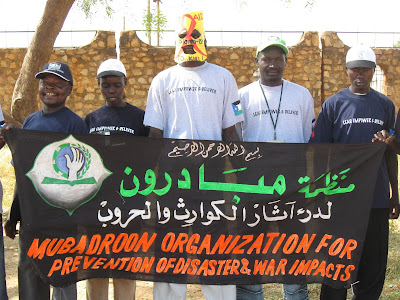
One of the Community Organizations we work with - didn't know they would be so morbid!!!

Brand new offices!

L to R: UNAIDS Representative, Governor Central Equitoria State, Chairperson Southern Sudan AIDS Commission (SSAC), Northern Sudan Minister of Health, Western Equitoria State Minister of Health, Deputy Chairperson SSAC, ?, UNAIDS Representative, Chairperson Association People Living with HIV (APLWHA) dNorthern Sudan.

Police Band - innauguration of new SSAC and APLWHA offices

Jebel Kujur in the background...


One of the hired buses carrying the APLWHA crashed on the way to their office inauguration - so sad! Luckily no one was seriously injured...

Raising the flags...

Poni and Ukele (2 of my staff)


My Ugandan banana ladies!


Parade coming up the main tarmac road near the Ministries

United Nations Mission In Sudan (UNMIS) contingent in the parade

Onlookers


One of the Community Organizations we work with - didn't know they would be so morbid!!!

Monday, September 15, 2008
Gotta love the rainy season
Here are some pics from my recent trip to Mundri. More specifically, the road between Mundri and Juba after it had rained overnight. Fun fun! As you can see the roads are seriously messed up.

 At one point our vehicle had to be pulled out of the mud by a crane (!!!)
 Plus there was gorgeous scenery along the way.
  And we bought some freshly-collected honey.
The trip itself went ok, it was just for two days so nothing too hard core. I went there with one of our donors to assess the VCT services provided by another organization to see if we can potentially support their work to expand services. What was there on the ground was appalling. Worse than Tambura. This org claimed to run 4 VCT sites, but upon further inquiry we found that one site was closed because they had no counselor to work there, one was closed because the roof had blown off the structure back in March 2008, and a third site was actually funded and run by another organization - this org just does supervision to the counselor. So they really only have functional operations in one place. Not to mention that they brought us to the site that was run by the other org as one of "their" sites. There were test kits which had expired in 2007, a sharps container that did not contain disinfectant, no confidential filing system, and it goes on and on and on. And that site was even closed because the counselor was away for the past 3 weeks for training! Their compound was literally built on top of an anthill so there were ants EVERYWHERE (outside, in the mess area, etc), their generator had blown up so there was no electricity, both their vehicles were grounded pending repairs, and all 4 of their motorbikes were also not functioning. Plus the entire 2 days we were there I didn't see them actually doing any work. It's like they just sit around and let their clinics run themselves. If you ever hear me complaining about Juba again, just remind me of the fact that I work for an organization that is able to get things done, whether it is running programs or fixing vehicles, I don't live on an anthill, and I work for a boss who actually provides support to the org instead of sitting around doing nothing.
 As you can see the roads are seriously messed up.

 At one point our vehicle had to be pulled out of the mud by a crane (!!!)
 Plus there was gorgeous scenery along the way.
  And we bought some freshly-collected honey.
The trip itself went ok, it was just for two days so nothing too hard core. I went there with one of our donors to assess the VCT services provided by another organization to see if we can potentially support their work to expand services. What was there on the ground was appalling. Worse than Tambura. This org claimed to run 4 VCT sites, but upon further inquiry we found that one site was closed because they had no counselor to work there, one was closed because the roof had blown off the structure back in March 2008, and a third site was actually funded and run by another organization - this org just does supervision to the counselor. So they really only have functional operations in one place. Not to mention that they brought us to the site that was run by the other org as one of "their" sites. There were test kits which had expired in 2007, a sharps container that did not contain disinfectant, no confidential filing system, and it goes on and on and on. And that site was even closed because the counselor was away for the past 3 weeks for training! Their compound was literally built on top of an anthill so there were ants EVERYWHERE (outside, in the mess area, etc), their generator had blown up so there was no electricity, both their vehicles were grounded pending repairs, and all 4 of their motorbikes were also not functioning. Plus the entire 2 days we were there I didn't see them actually doing any work. It's like they just sit around and let their clinics run themselves. If you ever hear me complaining about Juba again, just remind me of the fact that I work for an organization that is able to get things done, whether it is running programs or fixing vehicles, I don't live on an anthill, and I work for a boss who actually provides support to the org instead of sitting around doing nothing.
Thursday, September 4, 2008
Lack of Coordination
Sometimes I just want to scream. There is a certain organization working here (let's call them Org A) who runs over a dozen VCT (Voluntary Counselling and Testing for HIV) sites. Keeping in mind that care and support services to people who are HIV+ are extremely limited currently in Southern Sudan, this area happens to have an ART center (anti-retroviral therapy - drugs which slow down HIV's effect on a person's immune system). However, there had been no paediatric HIV programs anywhere in the area, or so they thought. At an HIV Partners Meeting a couple weeks ago, another organization (let's call them Org B) stated in a presentation that they were running a PMTCT program (this stands for Prevention of Mother to Child Transmission of HIV) at the same facility (a private hospital) where Org A was providing VCT services. The true definition of a PMTCT program is one that tests pregnant woman for HIV (called ANC testing) as well as the administration of Nevirapine, the drug that when administered in a single dose to both mother and child, reduces the rate of HIV transmission by almost 50%. Up until this point, the common knowledge was that there was no one administering Nevirapine in Southern Sudan, so all the pregnant women who test positive for HIV had to be referred to Uganda.
So the representation from Org A was quite surprised to hear that Org B was claiming to be running a true PMTCT program, in the same site as one of their own programs nonetheless. So after some inquiries on the part of Org A, it turns out that Org B was indeed administering Nevirapine, about 9 doses per month. The problem is, Org A didn't know about this, the heads of the org running the private hospital didn't know about this, the ART center in the area didn't know about this, the County AIDS Department didn't know about this, and the Ministry of Health at the County, State and National level didn't know about this. NO ONE did.
Any explanation I can think of for why Org B was not making this known does not hold water. If they were afraid the demand would be greater than their supply, then they should be screaming at donors and the Ministry of Health for more supplies. Org A told me that they would be able to find money for the drugs, it's just that they have no personnel trained on its administration. If that was the case, they could have bought the drugs for Org B. Had they known.
So what has happened is that dozens of HIV+ women each month were being referred to Uganda (when not many of these women even have ID cards let alone a passport) when the life-saving service they need is available in their same county and has been FOR A WHOLE YEAR.
This is CRIMINAL!
There is enough that is difficult about working in Southern Sudan, but there is no excuse for this lack of coordination and partnership, especially from an organization who is always present at partners meetings, etc. It makes me ill.
So the representation from Org A was quite surprised to hear that Org B was claiming to be running a true PMTCT program, in the same site as one of their own programs nonetheless. So after some inquiries on the part of Org A, it turns out that Org B was indeed administering Nevirapine, about 9 doses per month. The problem is, Org A didn't know about this, the heads of the org running the private hospital didn't know about this, the ART center in the area didn't know about this, the County AIDS Department didn't know about this, and the Ministry of Health at the County, State and National level didn't know about this. NO ONE did.
Any explanation I can think of for why Org B was not making this known does not hold water. If they were afraid the demand would be greater than their supply, then they should be screaming at donors and the Ministry of Health for more supplies. Org A told me that they would be able to find money for the drugs, it's just that they have no personnel trained on its administration. If that was the case, they could have bought the drugs for Org B. Had they known.
So what has happened is that dozens of HIV+ women each month were being referred to Uganda (when not many of these women even have ID cards let alone a passport) when the life-saving service they need is available in their same county and has been FOR A WHOLE YEAR.
This is CRIMINAL!
There is enough that is difficult about working in Southern Sudan, but there is no excuse for this lack of coordination and partnership, especially from an organization who is always present at partners meetings, etc. It makes me ill.
Friday, May 16, 2008
Violence against women - Sudan vs. the US
Maybe it's because at the moment I've been working on writing a section for one of our peer education manuals on the link between Gender Based Violence and HIV, but I'm feeling rather militant today so you all now have to deal with it.
Here's a stat for you: In Sudan, a girl is more likely to die in childbirth than to complete primary school.
Think about that for a moment.
In Sudan:
91% of women have no formal education
94% of women cannot read or write
99.8% of womenhave no electricity
87% of women do not have running water
40% of women report having been beaten
93% of women have lost at least one family member
68% of women of married women live in a polygamous marriage*
I consider this to be violence against women.
I've also felt the need to put up a few more annectodes that I think point out the attitude towards violence here in Sudan - especially violence against women. The same person who was involved in the lashing story from last year left the office for about 4 hours yesterday without letting anyone know where he was going. This is the second time this has happened so when he came back I asked him what was up. His story was this:
His sister was 5 months pregnant, and is not on good terms with her co-wife (it is very common here for people to have up to 4 wives). Yesterday the co-wife called his sister up on the phone and started insulting her and they had a fight over the phone. I don't know about what. So his sister then went to the house, where the co-wife proceded to beat her up, even though she was pregnant. She ended up miscarrying the child. The reason why he left the office was to help her file a court case against the co-wife. This is incredibly sad, but then he was calling his sister "not smart" and blaming because she went to the house to confront the co-wife even though she was pregnant!!!
Thank God that at least in the US, biggest donor of aid to social justice programs around the world, they have equal rights and respect for women everywhere. Oh, that's right, NO THEY DON'T!!! It's easy here in Sudan to think that these problems are unique and that women in more "developed" societies have it made. In a lot of ways, it's true. At 25 years old I am able to choose my partner and whether or not to get married, I am well educated, I have a job in the field of my choice and am financially independent, and can do pretty much whatever I want with my life, wherever in the world I fancy. Would I have this choice if I was born in Sudan? The answer is a resounding "no". If I was a Sudanese woman, I would be married with at least 2 or 3 children, my husband would have at least 1 other wife, I would not have gone to school so would probably not be able to even write my own name (many people's signatures here are actually their thumbprint). I would be expected to run my household and raise my children with the little money left over on pay day from my husband's drinking sprees. I would never have even seen a doctor or other trained medical provider other than a community health worker - that is if I was allowed by my husband to see one - and would probaly be born, live and die in the same town.
But there are also stories of hope here. Last week we had the launch of one of our programs in Yei, Lainya and Morobo counties, which included training people living with HIV as peer educators. As we were standing in the yard before the event, one of our facilitators pointed out a woman wearing a red dress with yellow flowers who was seated with a few other women. She said this woman was one of the peer educators who participated in the workshop, she was HIV positive and so was her 2 year old child. Halfway through the workshop her child passed away while being carried on her back. The child was literally fine in the morning, seemingly healthy and laughing, but by the afternoon had passed away, with no indication of how. After only 2 days of grieving, this woman returned to the workshop and participated for the rest of the sessions, determined to get all the information about staying healthy that she could so she could pass it on to others in her community.
Today Washington University in St. Louis, my alma matter, is holding the commencement ceremony for the Class of 2008. Also today, they are awarding Phyllis Schlafley an honorary doctorate, and Chris Matthews is the commencement speaker. Hear that? It's the sound of my head exploding. Read this excellent piece by Katha Pollitt published in The Nation which echoes exactly how I feel about the situation.
Backlash Spectacular
by Katha Pollitt
The Nation "
Washington University is giving Phyllis Schlafly an honorary doctorate. Let me run that by you again. Washington University, the distinguished 155-year-old seat of higher learning in St. Louis, is giving an honorary degree to Phyllis Schlafly--archfoe of the Equal Rights Amendment, the United Nations, Darwinism and other newfangled notions, and the promoter of innumerable crackpot far-right conspiracy theories who called the Bomb "a marvelous gift that was given to our country by a wise God." Her eighty-two years haven't mellowed her one bit: last year she blamed the Virginia Tech massacre on the English department; called intellectual men "liberal slobs"; advocated banning women from traditionally male occupations like construction, firefighting and the military; and defended men's property rights over their wives' vaginas ("by getting married, the woman has consented to sex, and I don't think you can call it rape"). The campus is in an uproar, and no wonder. After four years of hard work, female seniors get to watch their school honor someone who thinks they should park their diplomas in the kitchen sink. Washington U might as well bring in mad misogynist Chris Matthews as commencement speaker. Oh. You mean...? No!Yes.
Tell me the backlash against feminism isn't crackling up a storm. I tryto keep my eye on the big picture and the bottom line: education, employment, autonomy, power. Surely, I tell myself, the fact that half of all new med students are female is more important than Paris Hilton's omnipresent visage; that a woman has made the first viable run for the presidency says more about the United States than that media clowns like Matthews basically call her a crazy castrating bitch on a daily basis; or that Caitlin Flanagan, smarmy enemy of working mothers (and another big believer in compulsory sex for wives), won a National Magazine Award for reviews and criticism.
But sometimes I think we're truly going backward, as Republican hegemony, conservative Christianity and anti-feminist media propaganda take their cumulative toll. All those judges, all that money, all that shock jockery, all those magazines obsessively following stars' weight and baby bumps: it would be strange if they had no effect. As far as concrete setbacks go, look no further than the case of Lilly Ledbetter, whose right to sue for pay discrimination was denied by the Supreme Court last May. In a 5-to-4 decision, the Justices overturned the standard interpretation of existing law to declare that Ledbetter was twenty years too late: the victim of pay discrimination must sue within six months of the initial discriminatory act--never mind whether she knew about it (many employers, including Ledbetter's, forbid workers from discussing their salaries; she found out she was paid less than any man at her level from an anonymous tip). Given the realities of life, the Court has given employers the nod to pay women less, as long as they can keep the women in the dark for 180 days. In April a bill to restore women's right to sue failed in the Senate, 56-to-42, because for some reason everything now needs sixty votes to become law. John McCain said the bill would lead to too many lawsuits (hello? all it would have done was restore the law we'd lived with for forty-four years); what women needed was more "education and training." Because right now, women are just too dumb to merit equal pay. As Dahlia Lithwick wrote in a coruscating piece in Slate, if women take this sitting down, maybe they really are dumb.
The suspicion that women are dim would explain why Oklahoma has just passed a law requiring not only that women seeking abortions be forced to view sonograms of their fetuses but that the picture be taken in the way most likely to reveal the clearest picture--often up their vaginas. In other antichoice news, an abortion ban will be on the ballot again in South Dakota, this time with narrow exceptions for rape and incest. And mark June 7 on your calendar--it's Protest the Pill day, brought to you by the American Life League and other antichoice groups, which claim, despite the evidence, that "the Pill kills babies" by preventing implantation of fertilized eggs. Maybe it's good that the antichoice movement is outing itself as opposed to contraception, as prochoicers have long maintained and not many pundits have noted--but it also shows that they believe they can come out of the closet and not be dismissed as lunatics. Look for more struggles over government birth-control funding--already way down, thanks to budget cuts and inflation--as the antichoicers move the goal posts of how "life" is defined.
Yes, women are still making gains in education and--slowly--in politics and other areas. But long standing feminist gains are eroding: battered women's shelters, for example, are closing for lack of funds. And the advances haven't made the difference once hoped for. There are more powerful female Hollywood executives than ever, but as Manohla Dargis pointed out in a splendid rant (her word) in the New York Times, the movies are relentlessly male-focused: the conventional Hollywood wisdom is "Women can't direct. Women can't open movies. Women are a niche." Culturally, there's misogyny wherever you look: Grand Theft Auto IV, which offers players the opportunity to have sex with prostitutes and kill them, got rave reviews and is expected to have $500 million in sales its first week out. If there's a pro-woman cultural event with that kind of reach and impact, I'd like to hear about it. It certainly wouldn't be Vanity Fair's photo of tween icon Miley Cyrus, clad in nothing but a bedsheet at all of 15 years old--or the daily media onslaught urging women to focus on their babies like a Zen master contemplating a rock--when not taking pole-dancing lessons, getting Botoxed or catching up on the latest "studies" purporting to prove that they lack the drive and brains to do anything better with their brief time on earth. Feminism, please call home!"
*Source: Women for Women International
Here's a stat for you: In Sudan, a girl is more likely to die in childbirth than to complete primary school.
Think about that for a moment.
In Sudan:
91% of women have no formal education
94% of women cannot read or write
99.8% of womenhave no electricity
87% of women do not have running water
40% of women report having been beaten
93% of women have lost at least one family member
68% of women of married women live in a polygamous marriage*
I consider this to be violence against women.
I've also felt the need to put up a few more annectodes that I think point out the attitude towards violence here in Sudan - especially violence against women. The same person who was involved in the lashing story from last year left the office for about 4 hours yesterday without letting anyone know where he was going. This is the second time this has happened so when he came back I asked him what was up. His story was this:
His sister was 5 months pregnant, and is not on good terms with her co-wife (it is very common here for people to have up to 4 wives). Yesterday the co-wife called his sister up on the phone and started insulting her and they had a fight over the phone. I don't know about what. So his sister then went to the house, where the co-wife proceded to beat her up, even though she was pregnant. She ended up miscarrying the child. The reason why he left the office was to help her file a court case against the co-wife. This is incredibly sad, but then he was calling his sister "not smart" and blaming because she went to the house to confront the co-wife even though she was pregnant!!!
Thank God that at least in the US, biggest donor of aid to social justice programs around the world, they have equal rights and respect for women everywhere. Oh, that's right, NO THEY DON'T!!! It's easy here in Sudan to think that these problems are unique and that women in more "developed" societies have it made. In a lot of ways, it's true. At 25 years old I am able to choose my partner and whether or not to get married, I am well educated, I have a job in the field of my choice and am financially independent, and can do pretty much whatever I want with my life, wherever in the world I fancy. Would I have this choice if I was born in Sudan? The answer is a resounding "no". If I was a Sudanese woman, I would be married with at least 2 or 3 children, my husband would have at least 1 other wife, I would not have gone to school so would probably not be able to even write my own name (many people's signatures here are actually their thumbprint). I would be expected to run my household and raise my children with the little money left over on pay day from my husband's drinking sprees. I would never have even seen a doctor or other trained medical provider other than a community health worker - that is if I was allowed by my husband to see one - and would probaly be born, live and die in the same town.
But there are also stories of hope here. Last week we had the launch of one of our programs in Yei, Lainya and Morobo counties, which included training people living with HIV as peer educators. As we were standing in the yard before the event, one of our facilitators pointed out a woman wearing a red dress with yellow flowers who was seated with a few other women. She said this woman was one of the peer educators who participated in the workshop, she was HIV positive and so was her 2 year old child. Halfway through the workshop her child passed away while being carried on her back. The child was literally fine in the morning, seemingly healthy and laughing, but by the afternoon had passed away, with no indication of how. After only 2 days of grieving, this woman returned to the workshop and participated for the rest of the sessions, determined to get all the information about staying healthy that she could so she could pass it on to others in her community.
Today Washington University in St. Louis, my alma matter, is holding the commencement ceremony for the Class of 2008. Also today, they are awarding Phyllis Schlafley an honorary doctorate, and Chris Matthews is the commencement speaker. Hear that? It's the sound of my head exploding. Read this excellent piece by Katha Pollitt published in The Nation which echoes exactly how I feel about the situation.
Backlash Spectacular
by Katha Pollitt
The Nation "
Washington University is giving Phyllis Schlafly an honorary doctorate. Let me run that by you again. Washington University, the distinguished 155-year-old seat of higher learning in St. Louis, is giving an honorary degree to Phyllis Schlafly--archfoe of the Equal Rights Amendment, the United Nations, Darwinism and other newfangled notions, and the promoter of innumerable crackpot far-right conspiracy theories who called the Bomb "a marvelous gift that was given to our country by a wise God." Her eighty-two years haven't mellowed her one bit: last year she blamed the Virginia Tech massacre on the English department; called intellectual men "liberal slobs"; advocated banning women from traditionally male occupations like construction, firefighting and the military; and defended men's property rights over their wives' vaginas ("by getting married, the woman has consented to sex, and I don't think you can call it rape"). The campus is in an uproar, and no wonder. After four years of hard work, female seniors get to watch their school honor someone who thinks they should park their diplomas in the kitchen sink. Washington U might as well bring in mad misogynist Chris Matthews as commencement speaker. Oh. You mean...? No!Yes.
Tell me the backlash against feminism isn't crackling up a storm. I tryto keep my eye on the big picture and the bottom line: education, employment, autonomy, power. Surely, I tell myself, the fact that half of all new med students are female is more important than Paris Hilton's omnipresent visage; that a woman has made the first viable run for the presidency says more about the United States than that media clowns like Matthews basically call her a crazy castrating bitch on a daily basis; or that Caitlin Flanagan, smarmy enemy of working mothers (and another big believer in compulsory sex for wives), won a National Magazine Award for reviews and criticism.
But sometimes I think we're truly going backward, as Republican hegemony, conservative Christianity and anti-feminist media propaganda take their cumulative toll. All those judges, all that money, all that shock jockery, all those magazines obsessively following stars' weight and baby bumps: it would be strange if they had no effect. As far as concrete setbacks go, look no further than the case of Lilly Ledbetter, whose right to sue for pay discrimination was denied by the Supreme Court last May. In a 5-to-4 decision, the Justices overturned the standard interpretation of existing law to declare that Ledbetter was twenty years too late: the victim of pay discrimination must sue within six months of the initial discriminatory act--never mind whether she knew about it (many employers, including Ledbetter's, forbid workers from discussing their salaries; she found out she was paid less than any man at her level from an anonymous tip). Given the realities of life, the Court has given employers the nod to pay women less, as long as they can keep the women in the dark for 180 days. In April a bill to restore women's right to sue failed in the Senate, 56-to-42, because for some reason everything now needs sixty votes to become law. John McCain said the bill would lead to too many lawsuits (hello? all it would have done was restore the law we'd lived with for forty-four years); what women needed was more "education and training." Because right now, women are just too dumb to merit equal pay. As Dahlia Lithwick wrote in a coruscating piece in Slate, if women take this sitting down, maybe they really are dumb.
The suspicion that women are dim would explain why Oklahoma has just passed a law requiring not only that women seeking abortions be forced to view sonograms of their fetuses but that the picture be taken in the way most likely to reveal the clearest picture--often up their vaginas. In other antichoice news, an abortion ban will be on the ballot again in South Dakota, this time with narrow exceptions for rape and incest. And mark June 7 on your calendar--it's Protest the Pill day, brought to you by the American Life League and other antichoice groups, which claim, despite the evidence, that "the Pill kills babies" by preventing implantation of fertilized eggs. Maybe it's good that the antichoice movement is outing itself as opposed to contraception, as prochoicers have long maintained and not many pundits have noted--but it also shows that they believe they can come out of the closet and not be dismissed as lunatics. Look for more struggles over government birth-control funding--already way down, thanks to budget cuts and inflation--as the antichoicers move the goal posts of how "life" is defined.
Yes, women are still making gains in education and--slowly--in politics and other areas. But long standing feminist gains are eroding: battered women's shelters, for example, are closing for lack of funds. And the advances haven't made the difference once hoped for. There are more powerful female Hollywood executives than ever, but as Manohla Dargis pointed out in a splendid rant (her word) in the New York Times, the movies are relentlessly male-focused: the conventional Hollywood wisdom is "Women can't direct. Women can't open movies. Women are a niche." Culturally, there's misogyny wherever you look: Grand Theft Auto IV, which offers players the opportunity to have sex with prostitutes and kill them, got rave reviews and is expected to have $500 million in sales its first week out. If there's a pro-woman cultural event with that kind of reach and impact, I'd like to hear about it. It certainly wouldn't be Vanity Fair's photo of tween icon Miley Cyrus, clad in nothing but a bedsheet at all of 15 years old--or the daily media onslaught urging women to focus on their babies like a Zen master contemplating a rock--when not taking pole-dancing lessons, getting Botoxed or catching up on the latest "studies" purporting to prove that they lack the drive and brains to do anything better with their brief time on earth. Feminism, please call home!"
*Source: Women for Women International
Wednesday, December 5, 2007
What are you going to name your teddy bear?
Personally, I prefer the name Petunia.


My favorite quote from the teacher's muslim colleague on naming a class teady bear Mohammed, a name chosen by the students: "I know Gillian and she would never have meant it as an insult. I was just impressed that she got them to vote."
In other news, for the past several weeks I have been working with the coordinating AIDS body to organize the World AIDS Day event in Juba, and it finally happened this past Saturday. Here's a couple pictures I took at the event - the man at the podium is Salva Kiir, the president of Southern Sudan, and to his right is Riek Machar, the Vice President of "Emma's War" fame.
Despite all the stress of event planning, the day went fine. Not as many people were there as we had hoped, but that was mostly due to the fact that security guards at the entrance to the stadium had closed the doors and were not letting anyone in or out because the president was there. They let me through because I'm a Kawaja, but even our own staff had problems getting in. So unless they came at the very beginning, members of the community, who the event was really for, were kept away. Gotta love Sudan.
Also, in commemoration of World AIDS Day, we had a special Hash on Saturday. For those of you who don't know, the Hash House Harriers is a drinking club with a running problem where you join the pack of hounds (runners) to chase down the trail set by the hares (other runners), then gather together for refreshment, humor, and song. If it sounds like a fraternity, it sometimes leans in that direction. But it's all good. Great fun and exercise too! So I helped set the trail this past week (which by the way was lovely - started in Juba Town, ran by the WFP compound through the field next to the airport and then looped around back through UNMIS) and then conducted a condom demonstration for the group afterwards. Expats need to know how to use condoms correctly too! It was a hit - funny, and people kept coming up to me all weekend long saying "I heard about your show and tell".
NB: we have all our wooden penis models made by woodworkers in the local market. It's all about supporting the local businesses baby.Saturday, November 3, 2007
My brother is awesome
And here's his halloween "costume." I'm lobbying for him to keep the hair, it's just so damn cool.


In other news, I was on TV in Juba the other day, talking about my organization's HIV activities in Central Equitoria State during a Southern Sudan AIDS Commission meeting. How cool is that!
Also, my ankle is getting better. The swelling went down a bunch and the bruising is almost gone. It's fine enough to walk on and dance on (not 100% like my normal dancing, but good enough), but not yet ok enough to play rugby. Maybe next Friday.
And finally, here is a picture from Tambura - the Sudanese version of a gas station.
 The guy on the left is a policeman, and yes, he is wearing a fuzzy tiger print cowboy hat. There were several men wearing these, they must have gotten a shipment in from Uganda.


In other news, I was on TV in Juba the other day, talking about my organization's HIV activities in Central Equitoria State during a Southern Sudan AIDS Commission meeting. How cool is that!
Also, my ankle is getting better. The swelling went down a bunch and the bruising is almost gone. It's fine enough to walk on and dance on (not 100% like my normal dancing, but good enough), but not yet ok enough to play rugby. Maybe next Friday.
And finally, here is a picture from Tambura - the Sudanese version of a gas station.
 The guy on the left is a policeman, and yes, he is wearing a fuzzy tiger print cowboy hat. There were several men wearing these, they must have gotten a shipment in from Uganda.
Tuesday, September 18, 2007
UNMIS running, T-shirt mobs, and Kwacha
So I’ve officially been in Sudan a week now and it already feels as if I’ve been here a month. It’s amazing how quickly you adapt to a new environment when you’re carrying nothing but a few bags with you. It’s not like I have to think about arranging my living space, because I live in a container that holds a rather uncomfortable bed, plastic table and chair, and a dresser/bureau. The air conditioning unit, however, is quite new and runs silently – nary a purr – and because the room is so small (3 paces wide by 4 paces long) it cools off in no time.
Right now I’m sitting outside at the camp which is right on the Nile watching laundry dry on the fence and a little lizard is sunning herself along the wall watching the clothes dry with me. Here's a picture of the view:

The camp is right next to Juba’s port, which has no port-like qualities other than the fact that boats decide to dock there to unload their goods. The Japanese are building a tarmac road that will eventually go down to the port, but apparently they’ve been working on the same stretch of 200 meters for the past 3 months – everything must be perfect! When it is finished it will be Juba’s first tarmac road. There are a lot of met in hardhats walking around and flagging vehicles around the site, but not much work is going on. I don’t quite understand how the construction process goes, but there is a layer of tar, then they dump rocks on top of it, smooth it out, and then more tar? Maybe someone can enlighten me? Sunshine?
When I first got to Juba I wrote out an email with some thoughts about my first couple days – the text of which I am pasting below here:
“I arrived safe and sound in Juba yesterday - and all of my bags even arrived with me! It's a miracle! The trip was fairly stress free - except getting bumped from my flight from Nairobi to Juba and having to wait 4 hours in the airport. But I found a guy from Bolivia to chat with and even talked the airline out of charging me for my extra baggage, so all in all it was fine. I'm staying in a hotel-like compound for the first few weeks until my room in the guest house opens up. So it'll be living out of a suitcase for the first couple weeks. It is a nice place - there's wireless internet (because it's run by Indians), a/c, and it's right on the Nile river (which looks much like a tributary of the Amazon - fast current carrying plants along with it). All in all it's a lot like camp with WiFi - cold showers, bugs, brushing your teeth with water out of a water bottle, and eating in a canteen. Did I mention that it's awesome? I get to wear cargo pants and chacos to work. Needless to say, I'm sure the novelty of all this will fade away, and I'll soon be craving a hot shower and a place to wear cute shoes.
Juba is expensive. Going out to eat costs more than in the US - at least more than the places I eat at...not sure if that says more about me or about Juba... It rained last night and this morning, so everything is muddy. But not quite muddy enough to wear my blue-striped wellies. The potholes are less pot and more bathtub, which makes driving around in landrovers when you have to pee a very bad idea - it's hard to concentrate on holding more than one thing at a time, so you have to choose between steadying yourself with the handle above the window and, well, you know. I haven't seen the famed paved road yet, but I am assured it does indeed exist.
My favorite Juba quirk so far: a sign reading "Dry Cleaner" next to strings of laundry drying in the sun. Oh, and the Ethiopian food here rocks.”
Now a tugboat is bringing out one of the barges from the port. These things are so damn long they look like the spaceship at the beginning of Spaceballs – when it goes by it just keeps going and going and going carrying God knows what up and down the river. It looks like a pile of junk at one end – rusty cars, trucks and motorbikes, piles of bags and unidentified plastic, etc, and then on the other side there are containers.
I feel comfortable here. There’s no stress about looking presentable like there is in DC (cargo pants, a t-shirt and sandals do very nicely), and the little quirks about life here I take all in stride. Like having intermittent power (lanterns do have a certain charm), getting stuck in the mud, and having to deal with absolutely nothing going the way you planned it. I am the queen of last minute preparations and adapting under stress, so I think I’ll find a niche here and be happy.
I had to plan an event for several thousand people that took place this past Saturday. Up until Friday the preparations were going smoothly (except for the person bringing the t-shirts getting stuck in a town 4 hours away for 3 days) until it rained all morning on Saturday. When it rains here, everyone assumes that you don’t work. Everything just shuts down. This is mainly because there is only public transport on one road and it doesn’t run when it rains because the roads are so bad. But even if people live 2 blocks away they assume there is no work. So I had to call most of the staff to say that yes, the event was still on (it was supposed to stop raining in the afternoon) and yes, they need to be at the office as planned to help prepare. So we got started 3 hours late. The truck bringing the tables to the event got stuck in the mud on the way over, the audio system and generator couldn’t be picked up until it stopped raining, the office manager was nowhere to be found, the field where we were set up was all sorts of soggy, and less people showed up than would have otherwise. But everything worked out in the end, and my 7 hour event turned into a 4 hour event which was a blessing. Here's a picture:

and here's one of some cuties with one of our informational brochures on HIV prevention:

I was chatting with a few of the staff yesterday and their theory is that because of the war (which lasted over 20 years) everyone has gotten absolutely everything for free for so long whether from refugee camps, foreign aid, the army, or the government, that now the people who stayed in Sudan during the war don’t want to work. Because why should they? It’s not part of the culture anymore, and because they stayed in Sudan they didn’t learn English and can’t work in the NGO/UN world like the people who fled to Uganda or Kenya and then came back. The people who you see working in Juba are either Kenyans imported by businesses or returning Sudanese who have been living in Kenya or Uganda for a long time and have some education. So now we come to the t-shirt distribution at the event. Everyone expects free handouts and doesn’t understand why they shouldn’t just be able to have them. We had to keep them in a back office with police guards to keep away the mobs of people who would try to grab the t-shirts from whoever brought some out. Kids, adults, everyone. Craziness.
After the event we went to a party at another NGO compound and drank Carlsberg beer out of cans, waited for people to finish watching the Ireland vs. Georgia rugby match, and just hung out and did a bit of dancing. It is IMPOSSIBLE to have a conversation with anyone without one of you asking a) “who do you work for?” and b) “how long are you here for?” within the first two minutes. I had a bit of a freakout session when I realized that would be my social life for the next two years. Scary. I need to find other outlets…
I did, however, get some very good advice there from one of the guys that I played rugby with. He was asking how things were going so far and I was saying that my first week was super busy and that by the end of the event on Saturday I was just glad things ended without rioting or anything catching on fire. He replied that it may seem difficult, but that you should never lower your standards for work here because the lower your standards are the lower quality things will become. This may seem obvious to those of you who live in developed countries, but in a place where nothing works correctly it is important to keep in mind. People are smart, they are just not used to someone expecting a lot out of them.
Another tidbit from the party: the same guy as above who gave me advice asked me if I had worked in Africa before. I replied that I had, but in Southern Africa, not East Africa. He then asked, “Oh, so how are the Kwacha there?” Kwacha is the local word for foreigner or expat. At this point in time I didn’t know that yet. The only thing I knew as a Kwacha is the Zambian currency. So I then launch into a schpeal about how the Kwacha gained a lot of ground about a year ago due to the increase in the price of copper on the world markets which is mined in Zambia, which is all true. Then someone pulled me away. I didn’t find out what Kwacha meant here until the next day, at which point I felt like a total loser. Someone asks me how the expat community is in Southern Africa and I respond by giving a lecture on Zambian currency fluctuations. Serves me right. At least I wasn’t sober at that point plus was meeting everyone for the first time so I don’t remember who it was that asked me the question in the first place.
I went running on Sunday with a couple colleagues around the UNMIS complex, a loop that ends up being somewhere between 3 and 4 miles. It was absolutely lovely. I listened to Madonna’s confessions on a dance floor album while running (which was a bit of a mind bender –listening to the Café Ontario soundtrack that we used to have kitchen dance parties to (here’s a shout-out to Tiff, Ryan, Lisa, Amanda, Mukti and Alexis, I miss you guys so much!!!) while running through a swamp in Sudan. First we ran down a muddy stretch, then turned onto the old runway for the UN planes where there are a ton of HUGE helicopters still parked just chilling there along the whole stretch. The new runway is parallel to that “road” so small planes were landing nearby. After that we turned onto more dirt roads, where there were little yellow birds that looked like goldfinches, high grass, and relative calmness. Then we came to people guiding cattle across what looked like a river that had flooded the road. There was no way around, and the water was about 6 inches deep, so we had to take off our shoes and wade through. Twice. Where cattle had walked. Gross. I don’t even want to think about where that water had been. Eeeeeeeeeeewwwwwwwww. After that we squeezed through the bars of the back gate to the UN complex, and finished up the run waving at Bangladeshi guards and running past containers. And saw a rainbow J. There was also something called “Oxidation Pond” on the way. I don’t know why it is called that, do they dump a bunch of copper there to be oxidized? I have no idea.
That’s all for now, more to follow.
Peace.
Right now I’m sitting outside at the camp which is right on the Nile watching laundry dry on the fence and a little lizard is sunning herself along the wall watching the clothes dry with me. Here's a picture of the view:

The camp is right next to Juba’s port, which has no port-like qualities other than the fact that boats decide to dock there to unload their goods. The Japanese are building a tarmac road that will eventually go down to the port, but apparently they’ve been working on the same stretch of 200 meters for the past 3 months – everything must be perfect! When it is finished it will be Juba’s first tarmac road. There are a lot of met in hardhats walking around and flagging vehicles around the site, but not much work is going on. I don’t quite understand how the construction process goes, but there is a layer of tar, then they dump rocks on top of it, smooth it out, and then more tar? Maybe someone can enlighten me? Sunshine?
When I first got to Juba I wrote out an email with some thoughts about my first couple days – the text of which I am pasting below here:
“I arrived safe and sound in Juba yesterday - and all of my bags even arrived with me! It's a miracle! The trip was fairly stress free - except getting bumped from my flight from Nairobi to Juba and having to wait 4 hours in the airport. But I found a guy from Bolivia to chat with and even talked the airline out of charging me for my extra baggage, so all in all it was fine. I'm staying in a hotel-like compound for the first few weeks until my room in the guest house opens up. So it'll be living out of a suitcase for the first couple weeks. It is a nice place - there's wireless internet (because it's run by Indians), a/c, and it's right on the Nile river (which looks much like a tributary of the Amazon - fast current carrying plants along with it). All in all it's a lot like camp with WiFi - cold showers, bugs, brushing your teeth with water out of a water bottle, and eating in a canteen. Did I mention that it's awesome? I get to wear cargo pants and chacos to work. Needless to say, I'm sure the novelty of all this will fade away, and I'll soon be craving a hot shower and a place to wear cute shoes.
Juba is expensive. Going out to eat costs more than in the US - at least more than the places I eat at...not sure if that says more about me or about Juba... It rained last night and this morning, so everything is muddy. But not quite muddy enough to wear my blue-striped wellies. The potholes are less pot and more bathtub, which makes driving around in landrovers when you have to pee a very bad idea - it's hard to concentrate on holding more than one thing at a time, so you have to choose between steadying yourself with the handle above the window and, well, you know. I haven't seen the famed paved road yet, but I am assured it does indeed exist.
My favorite Juba quirk so far: a sign reading "Dry Cleaner" next to strings of laundry drying in the sun. Oh, and the Ethiopian food here rocks.”
Now a tugboat is bringing out one of the barges from the port. These things are so damn long they look like the spaceship at the beginning of Spaceballs – when it goes by it just keeps going and going and going carrying God knows what up and down the river. It looks like a pile of junk at one end – rusty cars, trucks and motorbikes, piles of bags and unidentified plastic, etc, and then on the other side there are containers.
I feel comfortable here. There’s no stress about looking presentable like there is in DC (cargo pants, a t-shirt and sandals do very nicely), and the little quirks about life here I take all in stride. Like having intermittent power (lanterns do have a certain charm), getting stuck in the mud, and having to deal with absolutely nothing going the way you planned it. I am the queen of last minute preparations and adapting under stress, so I think I’ll find a niche here and be happy.
I had to plan an event for several thousand people that took place this past Saturday. Up until Friday the preparations were going smoothly (except for the person bringing the t-shirts getting stuck in a town 4 hours away for 3 days) until it rained all morning on Saturday. When it rains here, everyone assumes that you don’t work. Everything just shuts down. This is mainly because there is only public transport on one road and it doesn’t run when it rains because the roads are so bad. But even if people live 2 blocks away they assume there is no work. So I had to call most of the staff to say that yes, the event was still on (it was supposed to stop raining in the afternoon) and yes, they need to be at the office as planned to help prepare. So we got started 3 hours late. The truck bringing the tables to the event got stuck in the mud on the way over, the audio system and generator couldn’t be picked up until it stopped raining, the office manager was nowhere to be found, the field where we were set up was all sorts of soggy, and less people showed up than would have otherwise. But everything worked out in the end, and my 7 hour event turned into a 4 hour event which was a blessing. Here's a picture:

and here's one of some cuties with one of our informational brochures on HIV prevention:

I was chatting with a few of the staff yesterday and their theory is that because of the war (which lasted over 20 years) everyone has gotten absolutely everything for free for so long whether from refugee camps, foreign aid, the army, or the government, that now the people who stayed in Sudan during the war don’t want to work. Because why should they? It’s not part of the culture anymore, and because they stayed in Sudan they didn’t learn English and can’t work in the NGO/UN world like the people who fled to Uganda or Kenya and then came back. The people who you see working in Juba are either Kenyans imported by businesses or returning Sudanese who have been living in Kenya or Uganda for a long time and have some education. So now we come to the t-shirt distribution at the event. Everyone expects free handouts and doesn’t understand why they shouldn’t just be able to have them. We had to keep them in a back office with police guards to keep away the mobs of people who would try to grab the t-shirts from whoever brought some out. Kids, adults, everyone. Craziness.
After the event we went to a party at another NGO compound and drank Carlsberg beer out of cans, waited for people to finish watching the Ireland vs. Georgia rugby match, and just hung out and did a bit of dancing. It is IMPOSSIBLE to have a conversation with anyone without one of you asking a) “who do you work for?” and b) “how long are you here for?” within the first two minutes. I had a bit of a freakout session when I realized that would be my social life for the next two years. Scary. I need to find other outlets…
I did, however, get some very good advice there from one of the guys that I played rugby with. He was asking how things were going so far and I was saying that my first week was super busy and that by the end of the event on Saturday I was just glad things ended without rioting or anything catching on fire. He replied that it may seem difficult, but that you should never lower your standards for work here because the lower your standards are the lower quality things will become. This may seem obvious to those of you who live in developed countries, but in a place where nothing works correctly it is important to keep in mind. People are smart, they are just not used to someone expecting a lot out of them.
Another tidbit from the party: the same guy as above who gave me advice asked me if I had worked in Africa before. I replied that I had, but in Southern Africa, not East Africa. He then asked, “Oh, so how are the Kwacha there?” Kwacha is the local word for foreigner or expat. At this point in time I didn’t know that yet. The only thing I knew as a Kwacha is the Zambian currency. So I then launch into a schpeal about how the Kwacha gained a lot of ground about a year ago due to the increase in the price of copper on the world markets which is mined in Zambia, which is all true. Then someone pulled me away. I didn’t find out what Kwacha meant here until the next day, at which point I felt like a total loser. Someone asks me how the expat community is in Southern Africa and I respond by giving a lecture on Zambian currency fluctuations. Serves me right. At least I wasn’t sober at that point plus was meeting everyone for the first time so I don’t remember who it was that asked me the question in the first place.
I went running on Sunday with a couple colleagues around the UNMIS complex, a loop that ends up being somewhere between 3 and 4 miles. It was absolutely lovely. I listened to Madonna’s confessions on a dance floor album while running (which was a bit of a mind bender –listening to the Café Ontario soundtrack that we used to have kitchen dance parties to (here’s a shout-out to Tiff, Ryan, Lisa, Amanda, Mukti and Alexis, I miss you guys so much!!!) while running through a swamp in Sudan. First we ran down a muddy stretch, then turned onto the old runway for the UN planes where there are a ton of HUGE helicopters still parked just chilling there along the whole stretch. The new runway is parallel to that “road” so small planes were landing nearby. After that we turned onto more dirt roads, where there were little yellow birds that looked like goldfinches, high grass, and relative calmness. Then we came to people guiding cattle across what looked like a river that had flooded the road. There was no way around, and the water was about 6 inches deep, so we had to take off our shoes and wade through. Twice. Where cattle had walked. Gross. I don’t even want to think about where that water had been. Eeeeeeeeeeewwwwwwwww. After that we squeezed through the bars of the back gate to the UN complex, and finished up the run waving at Bangladeshi guards and running past containers. And saw a rainbow J. There was also something called “Oxidation Pond” on the way. I don’t know why it is called that, do they dump a bunch of copper there to be oxidized? I have no idea.
That’s all for now, more to follow.
Peace.
Subscribe to:
Posts (Atom)